When most people think about sensory differences, they often imagine one very specific thing. They picture someone who can’t tolerate loud noises or who finds bright lights uncomfortable, as though sensory processing is simply a list of things you either like or dislike. My experience has never really been like that. It’s much harder to pin down because it changes from one day to the next. Something that barely registers on Monday can feel completely overwhelming on Wednesday, even though nothing about the environment has changed. The only thing that’s different is how much capacity my brain has left to deal with it.
I didn’t understand that for a very long time. I simply thought I was becoming irritable for no obvious reason. I’d find myself sitting in a room full of people who were chatting quite happily while I became increasingly aware of every individual sound. Someone tapping a keyboard would suddenly become impossible to ignore. A chair scraping across the floor would make me jump. I’d notice the hum of the projector, the air conditioning switching on and off, somebody rustling papers behind me and another person stirring their tea. None of those things was particularly loud, but together they seemed to compete for my attention until I could no longer separate the important information from the background noise.
What I know now is that my brain spends an extraordinary amount of time filtering the world. Most of us never notice that filtering because it happens automatically. Our brains quietly decide which sounds, sights, smells and sensations deserve attention and which can safely fade into the background. Mine can do that too, but it seems to work much harder to achieve the same result. Most of the time I don’t even realise it’s happening. Then, gradually and almost imperceptibly, the effort catches up with me. I haven’t suddenly become more sensitive; I’ve simply run out of the energy it takes to keep filtering everything else out.
That explains something I’d puzzled over for years. I could deliver a full day’s training to a busy room, answer questions, enjoy the conversations and leave feeling perfectly energised. On another day, in what looked like exactly the same environment, I’d find myself desperate for five minutes of quiet before lunchtime. I used to think that inconsistency meant I was doing something wrong. Now I understand that sensory overload isn’t really about the environment on its own. It’s about the relationship between the environment and the amount of capacity I have left when I arrive in it.
It’s also why my collection of fidget toys has grown rather larger than any sensible person probably needs. People sometimes laugh when they see them spread across my desk, but every one of them has earned its place. Some days I instinctively reach for a slider. On other days I need a twister. More often than not, I’ll find myself rolling my little purple magnetic textured balls between my fingers while I’m listening to someone speak. I’ve stopped trying to explain why one feels right on one day and not another because I honestly don’t know. The speed, the movement, the resistance, the texture and even the colour all seem to matter. My brain makes the decision long before I’m consciously aware of it.
For years I thought those little habits meant I was easily distracted. The irony is that they’re often the very things that allow me to concentrate. Giving my hands something purposeful to do seems to reduce the competition for attention elsewhere. The fidget isn’t distracting me from the meeting; it’s helping me stay in it. In much the same way, wearing headphones isn’t about shutting the world out. Quite often it’s about reducing just enough background noise that I can properly listen to the conversation I’m actually supposed to be having.
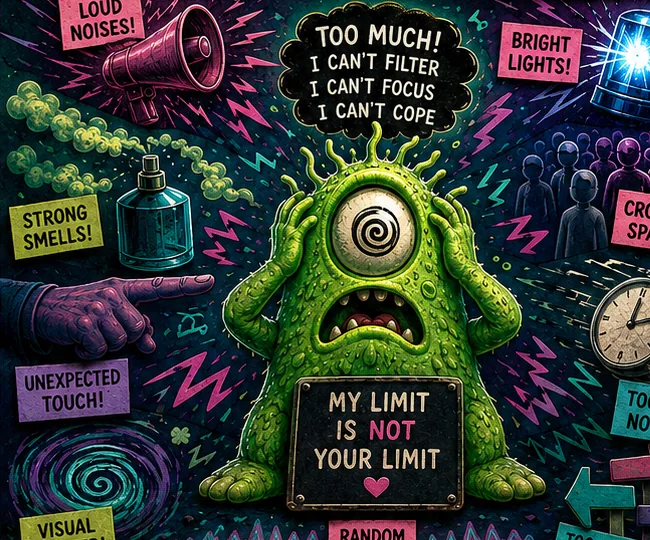
Meet the Sensory Overload Monster
The Sensory Overload Monster understands none of this. She isn’t particularly interested in subtlety. She simply waits until enough little things have gathered together and then quietly turns the volume up on all of them at once. By the time I notice she’s arrived, the room suddenly feels brighter, louder and busier than it did only a few minutes earlier. From the outside it can look as though I’ve become overwhelmed without warning. From the inside, it feels more as though I’ve been slowly filling a bucket all day and somebody has finally added the last drop.
Side A and Barry’s B-side
Her soundtrack could only ever be Firestarter by The Prodigy. It captures that feeling of intensity building faster than you can comfortably process it, where everything seems urgent, immediate and impossible to ignore. Barry, predictably, reaches for something completely different. His choice is Easy by Faith No More, not because he believes sensory overload is easy, but because he reminds me that the solution is often found by making the environment easier rather than expecting myself to work harder.
That has probably been one of the biggest changes since understanding my ADHD. I no longer see sensory adjustments as indulgences or excuses. If I move to a quieter table, wear headphones while I’m writing, take five minutes between meetings or reach for the fidget that happens to feel right that day, I’m not avoiding work. I’m making it possible to keep doing it well. Those tiny adjustments often make the difference between finishing the day with enough energy left to think clearly and arriving home feeling as though every part of my brain has been switched on since breakfast.
I sometimes think we underestimate how much invisible work our brains do before anybody sees the finished product. By the time I’ve delivered a workshop, chaired a meeting or written a report, my attention has already filtered thousands of sights, sounds, sensations and interruptions that most people will never know were there. That’s why sensory overload isn’t really about being unable to cope. It’s about recognising that every brain has a limit, and mine reaches it a little differently.
Barry never tells me to ignore the noise. He simply reminds me that even the strongest web needs moments of stillness if it’s going to stay strong enough to catch what really matters.