If there’s one thing I’ve learnt over the years, it’s that communication isn’t nearly as straightforward as we like to imagine. We tend to think that conversations are simply about choosing the right words, saying them out loud and trusting that everybody else hears exactly what we intended. If only it were that simple.
I’ve lost count of the number of times I’ve finished a conversation feeling perfectly happy, only to discover later that somebody thought I was annoyed, abrupt or dismissive. Equally, there have been times when I’ve walked away convinced somebody was upset with me, only to discover they hadn’t given the conversation a second thought. Somewhere between what was said, what was heard and what was meant, the message had quietly changed shape.
For years I assumed this was just something I wasn’t very good at. I worried that I came across as too direct, too enthusiastic or too intense. I still do, if I’m honest. The difference now is that I understand why it happens more often than I once realised.
My brain rarely thinks in neat, orderly sentences. By the time I’ve opened my mouth, I’ve usually travelled through half a dozen connected ideas and arrived at a conclusion that feels perfectly logical to me. Unfortunately, everybody else is still standing at the beginning of the journey, wondering how on earth I got to the destination so quickly.
The Crew have become wonderfully skilled at recognising this. They’ll occasionally stop me halfway through a conversation and say, ‘Hang on… you’ve started in the middle again.’ They’re nearly always right. Somewhere inside my own head I’d already explained the first half of the conversation. I just hadn’t realised I’d forgotten to say it out loud.
It’s become something of a standing joke in the office. If I begin with, ‘Well obviously…’ there’s a fair chance that whatever follows won’t be remotely obvious to anybody except me. The obvious bit happened three thoughts ago, somewhere along Barry’s web, and I’ve accidentally assumed everyone else has been following the same threads.
The funny thing is that I can often see the whole picture incredibly clearly. My brain joins ideas together at remarkable speed, spotting patterns and connections that have become one of the greatest strengths in my work. It’s one of the reasons I enjoy research, practice development and designing learning programmes so much. The difficulty comes when I need to reverse-engineer that thinking so somebody else can travel the same route with me.
Sometimes I forget to leave a map. Communication isn’t just about speaking, either. Email can be even more interesting. I’ll often fire off what feels like a perfectly straightforward message, only to realise later that I’d accidentally missed out the context because it seemed so obvious inside my own head. Equally, I’ve read messages from other people and convinced myself they sounded irritated, only to discover they’d written them in the supermarket queue between buying milk and remembering they needed bin bags. It’s remarkable how much emotion we can invent on behalf of other people.
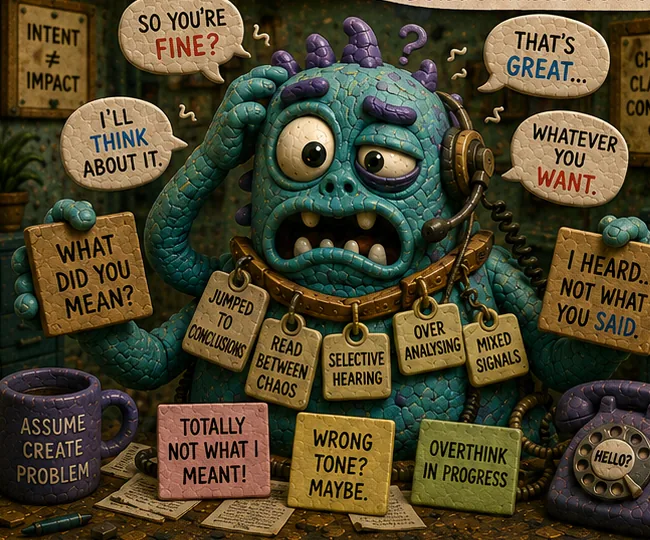
Meet the Misunderstanding Monster
That’s where the Misunderstanding Monster earns his place. He’s an absolute expert at filling in the blanks. Give him half a sentence and he’ll happily write the rest. Give him an email with no emojis and he’ll quietly suggest that somebody must be annoyed. Let someone pause for a little longer than usual before replying and he’ll begin constructing elaborate theories about what they’ve really meant.
The truth, of course, is usually much less dramatic. Somebody was busy. Somebody was tired. Somebody pressed send before proofreading. Somebody assumed I knew what they meant in exactly the same way I’d assumed they could follow the route through my own thinking. The Misunderstanding Monster doesn’t particularly care about evidence. He much prefers assumptions.
Side A and Barry’s B-side
His soundtrack could only really be Don’t Let Me Be Misunderstood by The Animals. It captures that familiar feeling of wanting people to see your intentions rather than just the words that happened to come out. There are moments when I think every ADHDer could probably use that title as an automatic email signature.
Barry, predictably, chooses something gentler. His B-side is We Can Work It Out by The Beatles, and I think that says rather a lot about how he approaches people. Barry never assumes that the first explanation is the right one. He asks questions. He checks the thread before deciding what made the web move. If something doesn’t quite make sense, he becomes curious rather than defensive.
I’ve tried to become more like Barry over the years. I’ve learnt to say, ‘Can I just check what you meant by that?’ instead of quietly inventing an answer. I’ve become better at adding the context that I once assumed everybody already had. I’m still not perfect at it. I still start in the middle of stories, occasionally send messages that make perfect sense only to me and sometimes interrupt because I’m frightened the thought will disappear if I don’t catch it while it’s still passing through.
The difference is that I no longer see those moments as evidence that I’m bad at communicating. They’re reminders that communication is something we build together. If you work with someone who has ADHD, one of the kindest things you can do is become curious before becoming certain. If something sounds unusually blunt, unusually enthusiastic or unexpectedly confusing, it might be exactly what it appears to be. Then again, it might simply be that you’ve caught them halfway through a journey their brain completed several minutes ago.
One question can often untangle far more than an assumption ever will. That’s true in social work, in leadership and, perhaps most importantly, in our personal relationships. Behaviour has many explanations, and words often do too. The more certain we become that we’ve understood somebody without checking, the more opportunity we give the Misunderstanding Monster to write the rest of the conversation on our behalf.
Barry has never been particularly interested in winning arguments. He’d much rather make sure everyone is standing on the same thread. Looking back, I think that’s probably one of the most valuable lessons he’s ever taught me. Communication isn’t about proving that I said the right thing or that somebody else heard the wrong one. It’s about staying curious long enough to discover where the two stopped matching up. Most of the time, once we find that point, the misunderstanding turns out to be much smaller than either of us first imagined.