By now, you’ve probably started to spot a pattern. The Inbox Monster filled my head with unfinished conversations. The Time Monster kept moving the goalposts. The Transitions Monster made every change of gear feel harder than it ought to, and the Side Quest Monster kept tempting me down fascinating little rabbit holes. On their own, none of them are particularly frightening. Together, they’re exhausting.
People often tell me I have a lot of energy. I usually smile because what they’re noticing isn’t really energy at all. It’s activity. My brain is almost always busy. Even when I’m sitting perfectly still, there’s a conversation going on. Ideas are colliding. Connections are being made. I’m remembering something I forgot yesterday while simultaneously planning tomorrow, replaying a meeting from this morning, spotting a typo on a slide and wondering whether that new framework would work better as a spider’s web than a flowchart.
It’s noisy in here. Not noisy in the way people often imagine. There aren’t voices. It’s more like standing in the middle of an air traffic control tower where every screen is displaying something important and every aircraft believes it should land first.
For years I assumed everybody experienced the world like that. When people said, ‘Just ignore it,’ I genuinely didn’t understand what they meant. Ignore which bit? The email? The idea? The conversation? The thing I’ve just remembered? The problem I haven’t solved yet? My brain has never been particularly good at deciding which thoughts should wait politely in line. They all arrive waving enthusiastically, convinced they’re the most important thing in the room.
That’s why I fidget.
If you’ve ever been in a meeting with me, you’ve probably seen a pen clicking away in my hand, a notebook gradually filling with doodles or one of my ever-growing collection of fidget toys making an appearance. I have rather a lot of them, and they’re all different because my brain seems to ask for different things on different days.
Some days it’s a twister. Some days it’s a slider. Other days it’s a pair of purple magnetic textured balls that quietly roll around in my hand while I’m listening. The speed matters. The movement matters. The texture matters. Even the colour matters. I couldn’t always tell you why my brain reaches for one rather than another, but it does. It’s almost as though part of me is instinctively selecting exactly the kind of sensory feedback I need in that moment.
It took me years to realise I wasn’t playing with them. I was regulating myself.
Keeping my hands occupied often helps the rest of my brain stay in the room. If my fingers have something useful to do, I’m usually listening more carefully, thinking more clearly and remembering far more of what’s being said. Some of my best ideas have started life as absent-minded doodles in the margin of a notebook. Some of my clearest thinking has happened while slowly turning a textured magnet between my fingers or rhythmically sliding a fidget backwards and forwards without even noticing I was doing it.
For years I worried that people would mistake fidgeting for not paying attention. The irony is that it’s often the opposite. If I’m quietly fiddling with something, there’s a very good chance I’m concentrating harder than anyone realises. What looks like a distraction is often helping me filter out all the other distractions competing for space in my head. My hands are keeping one small part of my brain occupied so the rest of it can stay with the conversation.
Meet the Overwhelm Monster
The difficulty comes when all those little threads start pulling at once. Every unfinished task joins Barry’s web. Every decision I haven’t made. Every email I’ve mentally replied to but haven’t actually sent. Every side quest I’ve carefully parked for another day. Every conversation I need to have. Every project folder waiting for attention. None of those things is particularly difficult on its own. But eventually they all start vibrating together.
That’s when she arrives.
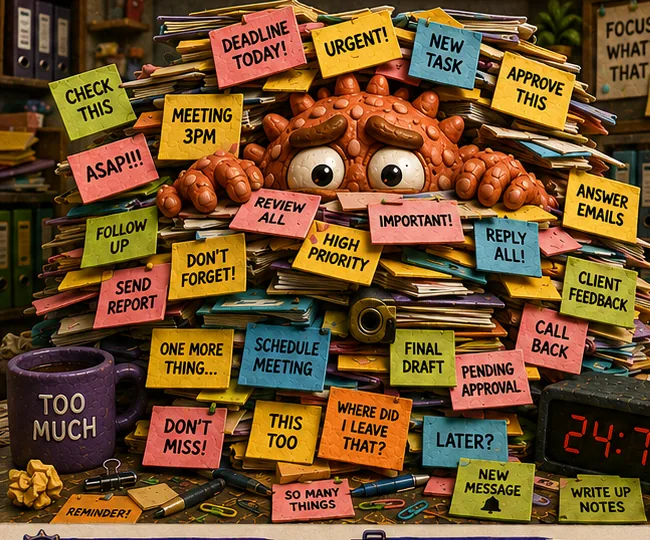
The Overwhelm Monster never crashes through the door. She doesn’t need to. She simply waits until every strand in Barry’s web is trembling at the same time. Then she quietly whispers, ‘How are you supposed to deal with all of this?’
She’s incredibly clever because she makes everything feel equally important. Replying to an email suddenly feels as significant as writing a paper. Ordering printer paper carries the same emotional weight as preparing for a keynote presentation. Choosing where to start becomes so difficult that sometimes the safest option feels like not starting anywhere at all. From the outside, that can look like procrastination. From the inside, it feels like gridlock.
Barry never tries to tear the web down. He knows that isn’t the answer. The web isn’t broken. It’s simply carrying too much movement. Instead, he climbs quietly onto the nearest strand. ‘You don’t have to untangle the whole web today,’ he says. ‘Just follow this one.’
I’ve learnt that Barry is usually right. When I’m overwhelmed, my instinct is to try to hold the whole picture in my head. Barry encourages me to shrink the picture instead. One email. One paragraph. One phone call. One slide. One thread. The amazing thing is that once one thread begins to settle, the others often become quieter too. They haven’t disappeared. They’re simply no longer demanding my attention all at once.
Side A and Barry’s B-side
The Overwhelm Monster grabs Side A with ‘Basket Case’ by Green Day. Not because people with ADHD are basket cases, but because that’s exactly what overwhelm can feel like when every thought is shouting over every other thought and my brain can’t decide which one to listen to first.
Barry’s B-side is, unsurprisingly, much gentler: ‘The Middle’ by Jimmy Eat World. I don’t think he’s talking about mediocrity. I think he’s talking about balance. The answer isn’t an empty inbox or a perfectly organised life. It’s finding the middle ground where there are enough threads to keep life interesting, but not so many that the whole web starts shaking.
If you work with someone who has ADHD, remember that overwhelm is rarely caused by one big task. More often it’s the accumulation of dozens of tiny demands that nobody else can see. Every interruption, every unexpected change, every decision and every unfinished task adds another vibration to the web. Sometimes the kindest question isn’t, ‘Why haven’t you done it yet?’ It’s, ‘Which thread shall we start with?’
For years I thought I needed to become better at coping with overwhelm. These days, I think Barry has taught me something much more useful. Don’t fight the whole web. Just find the next thread.