I’ve been an ADHD social worker for far longer than I’ve known I’ve been an ADHD social worker.
For most of my career, I didn’t have the language for why my brain worked the way it did. I just assumed everyone else found the world as noisy, as interesting and as relentlessly busy as I did. I thought everybody walked into the office with three brilliant ideas, remembered a conversation from six weeks ago because someone used one familiar word, started answering an email before spotting something else that needed doing, and somehow ended up wondering why they’d opened the stationery cupboard.
It never occurred to me that there was another way to experience the world.
Looking back now, the clues were everywhere. My notebooks were full of ideas joined together with arrows, circles and sketches that made perfect sense to me and absolutely nobody else. I was rarely thinking about just one case because every conversation sparked connections to ten others. My inbox wasn’t a filing cabinet; it was a living to-do list. If I replied to your email immediately, it was because I’d learnt that if I didn’t do it there and then, there was every chance I’d remember it again next Thursday at half past nine while brushing my teeth.
I wasn’t disorganised. I was trying to manage a brain that had developed its own operating system.
That’s one of the reasons I’ve always loved social work. It rewards curiosity. It asks us to see connections that other people might miss. It encourages us to understand the whole person rather than reducing them to a single event or diagnosis. The very things that sometimes made me feel different also became some of my greatest professional strengths. I could often spot patterns across systems, connect seemingly unrelated information and see possibilities where others saw dead ends.
Of course, every strength has its shadow. The same brain that makes connections at lightning speed also struggles to decide which of fifty competing thoughts deserves attention first. That’s where today’s monster lives.
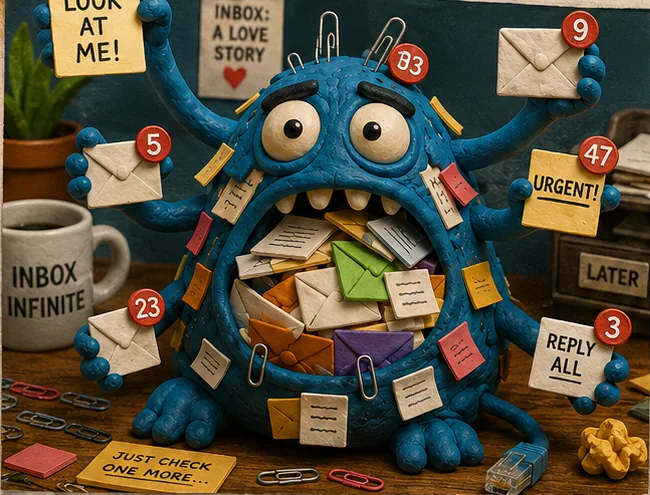
Meet the Inbox Monster
I call him the Inbox Monster.
He isn’t fuelled by laziness or poor organisation. He’s fed by possibility. Every email could be important. Every message might need an immediate reply. Every notification feels as though it deserves to be at the front of the queue. Before long, they stop being individual tasks and become one enormous wall of responsibility that’s impossible to climb.
Barry, the keeper of the web, just smiles.
He knows every unfinished email, every half-written reply and every promise to ‘do that later’ adds another strand to the web. One thread isn’t a problem. Neither are ten. But eventually the web becomes so crowded that it’s difficult to see which thread you’re actually supposed to follow. Barry never tells me to destroy the web. He simply reminds me to hold one thread at a time.
Side A and Barry’s B-side
On Side A of the Neurospicy Monsters LP, the Inbox Monster claims ‘One Way or Another’ by Blondie. It fits him perfectly. Unfinished tasks have a habit of following me everywhere. I can leave the office, walk the dog, sit down to watch television and suddenly remember the email I forgot to send. The Monster doesn’t need to shout. He simply keeps tapping me on the shoulder until I notice him.
Flip the record and Barry’s B-side is ‘Connection’ by Elastica. He isn’t pretending one song can magically clear an inbox. He’s reminding me that meaningful connection matters more than frantic reaction. One thoughtful reply is better than ten rushed ones, and one completed conversation is worth far more than twenty unfinished drafts.
If you’re reading this because you recognise yourself, I hope you’ll discover that many of the things you’ve spent years apologising for aren’t character flaws at all. They’re often the predictable consequences of a brain that’s trying to process a world that wasn’t designed with it in mind.
And if you’re reading this as a colleague, manager, friend or family member, welcome. You are not expected to become neurodivergent to understand us. You don’t need to think like we do. But I hope that, over the next month, you’ll begin to see why what looks like forgetfulness, distraction or disorganisation often has a much richer story behind it.
This is the first of twenty-two monsters you’ll meet during ADHD Awareness Month. Some will make you laugh. Some might make you wince with recognition. A few may even explain things you’ve never quite been able to put into words.
Barry will be here throughout, quietly watching from the centre of his web.
After all, he’s been making sense of connected thinking far longer than any of us.