
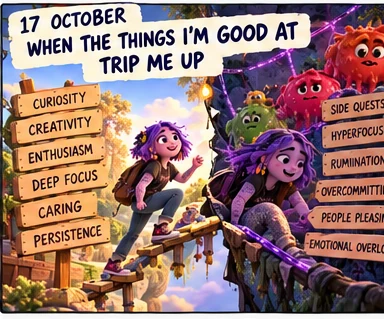
Something has become increasingly obvious while I’ve been writing this journal: quite a few of the things that make ADHD difficult for me live remarkably close to things I value about myself.
I like being curious, but curiosity is also how I disappear down side quests. I care about doing things properly, which is useful until responsibility expands to include everything I can see. I think deeply about problems, which helps me make connections other people might miss, but the Rumination Monster is perfectly capable of borrowing exactly the same equipment. I can become completely absorbed in something I care about and produce an extraordinary amount of work, but hyperfocus doesn’t necessarily check whether I’ve eaten lunch before deciding that nothing else exists.
For years I found this confusing because we’re encouraged to divide characteristics into strengths and weaknesses. Strengths belong in one box and difficulties in another, preferably with a development plan attached. My experience is much messier. The same part of me can be enormously useful in one context and exhausting in another.
The problem isn’t that curiosity, persistence, sensitivity, enthusiasm or deep focus are secretly bad qualities. It’s that context, capacity and intensity matter. Being able to focus deeply is useful when I have chosen the thing I’m focusing on and can eventually disengage from it. It’s less useful when my attention has effectively locked the door from the inside while the rest of my day queues outside.
Understanding that has changed the way I think about ADHD strengths too. I’m wary of the idea that ADHD is a superpower because it can make genuinely disabling experiences sound like they simply need better marketing. At the same time, I don’t recognise myself in accounts that describe ADHD only through deficits either.
My brain is neither superhero nor disaster zone. It’s a brain with a particular collection of tendencies, some of which I love, some of which drive me completely round the bend, and several of which change category depending on what is happening around me.
Barry, naturally, finds this completely unsurprising. A web needs tension to hold its shape, but too much tension breaks threads. Connections make it strong, but too many things hitting the web at once become overwhelming. There isn’t a simple setting marked good amount of web.
Perhaps that’s the useful question for me now. Instead of deciding whether a particular ADHD characteristic is a strength or a weakness, I can ask what helps it work well, what makes it harder to manage and how I recognise when the balance has shifted. That feels much closer to my actual experience, and considerably less exhausting than trying to decide whether I’m supposed to be celebrating my brain or apologising for it.