
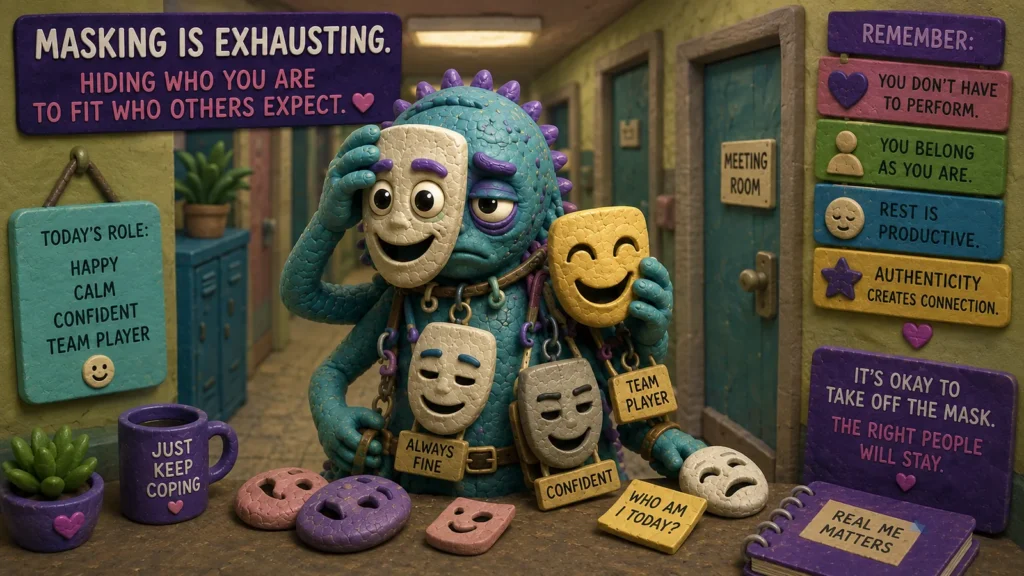
There have been plenty of points in my career when I looked as though I was coping beautifully because nobody could see how much effort was going into making that true. I arrived prepared, delivered what I needed to deliver and appeared calm enough from the outside. What was less visible was the amount of rehearsal, checking, note-making, self-monitoring and recovery wrapped around the performance.
That is one of the reasons masking is difficult to recognise. It often looks like success. If somebody has learnt how to hide confusion, suppress movement, compensate for memory difficulties and imitate the expected rhythm of a workplace, the system may conclude there is no barrier because the person has become very skilled at carrying it privately.
I do not think all masking is conscious. Much of mine developed through ordinary social learning. You notice which behaviours attract comments, which questions are welcomed and which ones are interpreted as awkward, how much enthusiasm is considered acceptable and how still a professional body is apparently supposed to remain in a meeting. Gradually you become better at editing yourself before anybody else has to.
The cost is not always immediate. Sometimes I can mask my way through an entire day and only notice the price afterwards when I have no appetite for conversation, every sound feels louder or a very small decision suddenly becomes impossible. From the outside the day went well. From the inside, I used far more energy than the visible task explains.
Understanding masking has made me much more cautious about praising people for appearing unaffected. Calm presentation does not necessarily mean low impact, and competence does not tell us how sustainable the current way of working is. If support is only offered once somebody visibly falls apart, we are rewarding the ability to hide difficulty until hiding it becomes impossible.
For me, reducing masking has been less about revealing everything and more about making small choices that cost less. Using a fidget without apologising for it, asking for something in writing, saying I need a few minutes to process, or admitting that a day of constant interaction has used up more of me than it appears to have done are all tiny acts of spending less energy on looking unaffected.
Barry has never cared much for performance. He is interested in whether the web holds, not whether every thread looks identical while doing it. I am learning to be more interested in that too.