
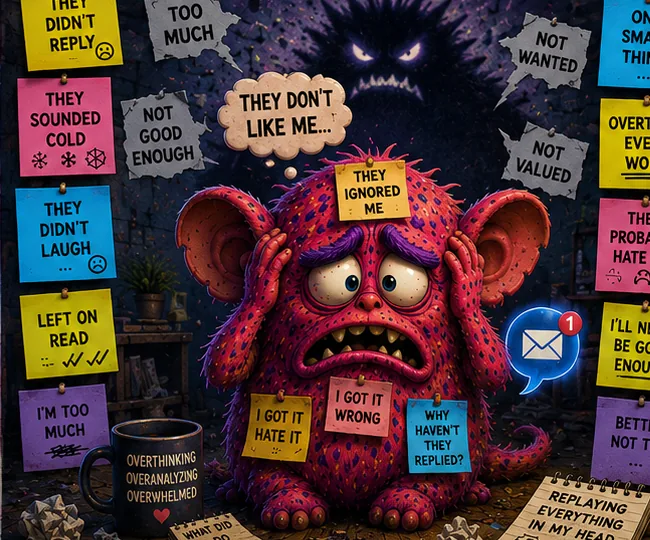
I’ve never needed very much evidence to convince myself that somebody might be upset with me. That sounds rather dramatic when I write it down, but I don’t think it’s quite what people imagine. I’m not constantly worrying that everyone dislikes me. Most of the time I’m perfectly happy getting on with life. Then something small happens. An email sounds a little shorter than usual. Someone doesn’t reply when I expected them to. A meeting finishes feeling slightly different to how I’d imagined it would. A joke doesn’t quite land. Someone walks past without saying hello because they’re concentrating on something else entirely.
My brain notices, and then it starts asking questions. At first, they’re perfectly reasonable questions: did I miss something, have I misunderstood, are they having a difficult day? They’re the sorts of thoughts most people probably have from time to time. The difference is that my brain doesn’t always know when to stop asking them. It has a habit of collecting little pieces of information and trying to build a complete picture before it has anywhere near enough evidence to do so.
Looking back, I can see that I’ve always done it. Long before I knew anything about ADHD, I was incredibly good at spotting tiny changes in people’s behaviour. I noticed differences in tone, expressions, body language and the rhythm of conversations. That ability has actually been incredibly useful throughout my career. Social work teaches you to notice the things that don’t quite fit, the moments where something changes, the inconsistencies that deserve a little curiosity rather than immediate certainty. The difficulty is that sometimes my brain forgets to distinguish between noticing something and knowing what it means.
If somebody is quieter than usual, there could be hundreds of explanations. They might be tired. They might have had bad news. They might simply be concentrating on something else. Equally, they might be irritated with me. The truth is that I don’t know until I ask, yet my brain has an unfortunate tendency to treat its first theory as though it were established fact.
Meet the Rejection Monster
That’s where the Rejection Monster quietly slips into the story. She isn’t especially dramatic; she whispers. She’ll suggest that I’ve upset somebody, that I probably shouldn’t have said something, that they’re disappointed or that I’ve got something completely wrong. The remarkable thing about her is how convincing she can sound despite having almost no evidence whatsoever.
I’ve learnt over the years that the Rejection Monster is an extraordinary storyteller. Give her one unanswered email and she’ll happily write three chapters explaining why someone has fallen out with me. Let somebody postpone a meeting and she’ll briefly convince me it’s because they’ve suddenly realised I’m completely incompetent. She’s wonderfully creative, just not especially accurate.
The strange thing is that this isn’t really about confidence. People sometimes assume that because I stand up in front of hundreds of people, speak at conferences and happily share ideas, I must be immune to those sorts of feelings. I wish. Confidence and sensitivity are perfectly capable of existing together. I can absolutely believe in my work while still having moments where I wonder whether I’ve got something completely wrong. One doesn’t cancel out the other.
The difference these days is that I recognise the Rejection Monster much sooner than I used to. Years ago, I would have believed every story she told me. If somebody hadn’t replied to an email, I assumed I’d done something wrong. If feedback felt uncomfortable, I quietly carried it around for days, replaying the conversation and wondering what I should have done differently. I rarely questioned whether there might be another explanation. Now I know to be a little more suspicious, not of other people, but of the stories my own brain is writing before anybody else has had the chance to contribute.
I’ve discovered that time is often the Rejection Monster’s greatest enemy. The things that feel painfully obvious at half past four on a Tuesday afternoon frequently look very different by Wednesday morning. The email I was convinced sounded annoyed turns out to have been written between meetings. The delayed reply arrives with an apology because somebody had been off sick. The feedback I initially experienced as criticism becomes something genuinely useful once the emotional sting has settled. Nothing about those situations changed overnight; what changed was the amount of space I gave myself before deciding what they meant.
Side A and Barry’s B-side
The Rejection Monster’s soundtrack could only really be Everybody Hurts by R.E.M. There’s something deeply compassionate about that song. It doesn’t pretend difficult feelings don’t exist; it simply reminds us that we’re not the only people who experience them. I think that’s an important distinction. Feeling rejected isn’t a sign that we’re weak. It’s part of being human.
Barry, unsurprisingly, reaches for a different record. His choice is Dog Days Are Over by Florence + The Machine, and I don’t think it’s because he expects me to simply cheer up. Barry has never been particularly interested in pretending difficult emotions don’t exist. He just knows they aren’t permanent. Feelings have a habit of convincing us they’ll last forever, but they rarely do. They rise, they settle and, given enough time and enough evidence, they usually move on.
One of the kindest things I’ve learnt to do for myself is delay the verdict. I don’t have to decide what somebody meant immediately, and I don’t have to answer every uncomfortable feeling the moment it arrives. Sometimes I simply need to wait until I have more information. Sometimes I need to ask the question instead of inventing the answer. Sometimes I need to remember that other people’s behaviour tells me far more about what’s happening in their world than it necessarily does about my place in it.
That has made me a better social worker as well as a happier person. Professional curiosity isn’t just something we use with the people we support; it’s something we can use with ourselves. Instead of asking, ‘What’s wrong with me?’ I’ve learnt to ask, ‘What evidence do I actually have?’ More often than not, the answer is, ‘Not enough yet.’
Barry has always been remarkably good at waiting for the evidence. He never looks at one trembling thread in the web and decides the whole thing is about to collapse. He waits, watches and notices which other threads begin to move before deciding what might have caused the vibration in the first place. I’ve started trying to do the same, and it turns out that giving myself permission not to know is far kinder than rushing to a conclusion that was never true in the first place.