One of the running jokes with the Crew is that I never seem to start at the beginning. I’ll appear in the doorway and announce, ‘…so that’s obviously why it couldn’t have been a deprivation of liberty,’ as though we’ve all been having the same conversation. The trouble is, we haven’t. The first half happened entirely inside my own head, and I’ve forgotten that everyone else wasn’t invited.
For years I assumed everyone thought like this. I genuinely believed that everybody’s brain made the same connections, jumped across the same ideas and somehow landed in the same place. It wasn’t until I was diagnosed that I began to understand that my route from A to B often isn’t A to B at all. It’s A to M, back to C, across to Z, with a quick stop at something I read six years ago before finally arriving at B. The journey feels almost instantaneous to me, which is why I often forget that everybody else hasn’t travelled it.
This way of thinking has a name: associative thinking. Rather than storing information in neat folders, many ADHD brains build enormous networks of connections. One thought sparks another, which sparks another, until an entire web of related ideas lights up. Mention professional curiosity and I might immediately think about executive functioning, which reminds me of cognitive load, which links to neurodiversity, which reminds me of a conversation I had last month, which connects to something Barry would say, and suddenly I’m talking about spider webs. It sounds chaotic, but there is an internal logic to it that’s surprisingly consistent.
Looking back, I can see just how much of my career has been shaped by associative thinking. Social work rarely presents us with neat, isolated problems. Families, communities, legislation, relationships and human behaviour are all connected. I’ve always loved trying to understand the whole picture rather than just one corner of it. The ability to spot patterns, see links between seemingly unrelated pieces of information and ask, ‘What does this remind me of?’ has become one of my greatest strengths. It’s helped me design training, build frameworks and solve problems because my brain is constantly weaving ideas together rather than filing them away separately.
Of course, every strength has a flip side. Because my brain travels those connections so quickly, I often forget that nobody else has been on the journey with me. I’ll arrive at what feels like the obvious conclusion without explaining the bridges I crossed to get there. It can make me sound as though I’ve changed the subject completely when, from my perspective, I’ve simply followed the next thread in the web.
Meet the Transitions Monster
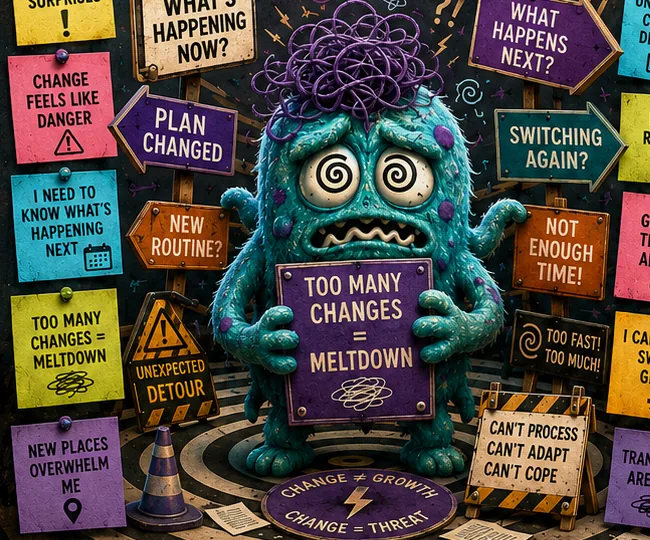
That’s where today’s monster makes his appearance.
The Transitions Monster doesn’t really like straight lines. More importantly, he makes changing gear harder than it ought to be. Moving from one task, thought, context or demand into another can take far more effort than it looks from the outside. Sometimes the difficulty isn’t knowing what comes next; it’s persuading my brain to let go of where it already is and move there.
Barry, unsurprisingly, isn’t the least bit worried. From the centre of his web, he can see every connection. ‘The web isn’t random,’ he reminds me. ‘Every strand joins another for a reason. Sometimes you just have to show people the path you took.’
That simple lesson changed how I communicate. Instead of assuming people can see the same web I can, I’ve learnt to leave little signposts. ‘This reminds me of…’ ‘The reason I’ve jumped to this is…’ ‘Can I just join these two ideas together?’ Those tiny phrases invite people onto the journey instead of expecting them to magically appear at the destination with me.
Side A and Barry’s B-side
The Transitions Monster takes Side A with ‘Changes’ by David Bowie. Change of any kind asks my brain to release one set of expectations and build another, and that can take more effort than people realise. Barry’s B-side is ‘I Can See Clearly Now’ by Johnny Nash, because once the route through the web is visible and the next step is clear, transitions become much easier to navigate.
I sometimes wonder how many times I’ve apologised for ‘going off on one’ when, actually, I wasn’t off track at all. I was simply following a different map. ADHD has taught me that there isn’t only one way to think, and social work has shown me that the most interesting answers are often found by people who are prepared to look beyond the obvious.
So if I ever seem to start in the middle of the story, do stop me. Ask me how I got there. I promise there was a beginning. Barry and I just reached the end of the thread before we remembered to invite everyone else onto the web.