When I first started learning about masking, I imagined it as something much more deliberate than it usually feels in real life. The word makes it sound as though there’s a false version of me that I consciously put on before leaving the house and remove when I get home.
My experience is nowhere near that tidy. A lot of masking developed gradually because human beings notice what gets rewarded, what attracts criticism and what makes social situations easier. You learn not to interrupt even when holding onto the thought takes most of your working memory. You learn to keep your hands still in environments where fidgeting attracts attention. You develop systems that hide forgetfulness, rehearse what you’re going to say, monitor whether you’re talking too much and try to look as though switching attention is effortless when your brain is still halfway through the previous thing.
Eventually some of it stops feeling like a strategy and starts feeling like personality. That makes conversations about unmasking complicated because I don’t particularly want to strip away every adaptation I’ve ever learnt. Some are useful social skills. Some make working with other people easier. Some reflect consideration rather than camouflage, and I’m not interested in replacing I must hide every ADHD trait with a new rule saying I must display every ADHD trait to be authentic.
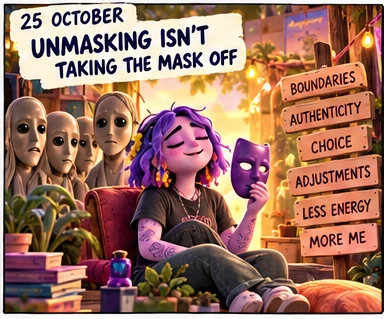
For me, unmasking is much more about choice. It’s noticing where I’m spending enormous amounts of energy appearing unaffected by something and asking whether I actually need to. It’s being able to use a fidget without worrying that somebody will mistake regulation for inattention. It’s saying that I need information written down rather than pretending I’ll remember it. It’s building space between meetings because transitions cost me something, and occasionally telling the Crew that my brain has reached capacity rather than working twice as hard to make sure nobody notices.
There are environments where I still mask more than others because safety, power and context matter. Being authentic doesn’t require handing everybody unrestricted access to every part of yourself. What matters to me is having more control over the decision.
Barry doesn’t seem terribly interested in whether I look neurotypical. Spiders aren’t known for their commitment to conventional workplace behaviour, so perhaps that’s unsurprising. He is interested in how much energy I’m spending holding a particular thread in place and whether that energy is actually buying me anything useful.
I’m learning to ask the same question. Unmasking, for me, isn’t taking off a costume and discovering the real me underneath. It’s gradually needing the costume less often.