
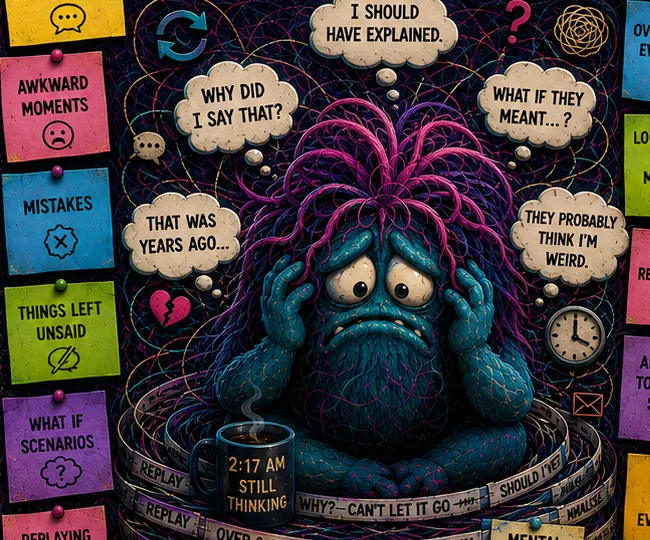
There are certain conversations that my brain simply refuses to let go of. Most people seem able to finish a meeting, drive home and move on with the rest of their day. I admire that enormously because it isn’t something that has ever come naturally to me. I’ll often leave a meeting convinced it’s over, only to find it quietly wandering back into my thoughts while I’m making a cup of tea, walking the dog or trying to decide what to cook for dinner. Suddenly I’ll remember a sentence somebody said, wonder whether they meant something different by it, or think of the perfect response several hours after it would have been useful. By then, of course, the conversation has long since moved on. Mine hasn’t.
For years I thought this was simply part of being reflective. Social workers spend a great deal of time thinking about conversations, relationships and decisions, and rightly so. Reflection is one of the things that helps us become better practitioners. Looking back at something with the benefit of time often allows us to notice things we missed in the moment. I’ve learnt an enormous amount throughout my career by taking the time to think carefully about my practice, and I wouldn’t want to lose that part of how my brain works.
The difficulty is that my brain doesn’t always know when reflection has stopped being useful. Sometimes I’m no longer learning anything new. I’m simply revisiting the same thought from a slightly different angle, convinced that if I look at it one more time I’ll finally arrive at the answer that has somehow escaped me during the previous dozen attempts. It feels productive because I’m thinking so hard, yet when I finally notice how much time has passed, I realise I’ve travelled round in circles rather than forwards.
I’ve often wondered whether that’s the downside of an associative brain. One idea naturally connects to another, which reminds me of something else, which leads me back to where I started carrying a few more connections than before. The web grows richer, but occasionally it becomes so densely connected that I struggle to find my way back out again. Instead of following a thread towards something new, I find myself repeatedly walking the same familiar paths.
Meet the Rumination Monster
The Rumination Monster rather enjoys that. Unlike some of the other Monsters, he doesn’t need to make a dramatic entrance. He simply settles down beside me with the patience of someone who has absolutely nowhere else to be. Every time I think I’ve finished with a particular thought, he’ll gently tap me on the shoulder and suggest there might just be one more thing worth considering. Perhaps I misunderstood that email. Perhaps that conversation meant something different. Perhaps I should replay it again, just to make sure I haven’t missed anything important.
He’s remarkably persuasive because he sounds sensible. After all, what’s wrong with being thorough? The problem is that thoroughness eventually becomes repetition, and repetition has a curious way of masquerading as progress. I can spend half an hour mentally revisiting the same conversation and emerge feeling as though I’ve worked incredibly hard, despite not having reached a conclusion that wasn’t available to me within the first five minutes.
That habit has an unfortunate tendency to appear at night. I suspect I’m not alone in discovering that bedtime is when unresolved thoughts suddenly decide they deserve centre stage. It’s extraordinary how many conversations become fascinating at two o’clock in the morning, particularly when there is absolutely nothing I can do about them until the following day. My brain seems entirely unconcerned by this practical limitation. If anything, it appears to regard the middle of the night as the ideal opportunity to hold an internal case conference. I’ve won some spectacular imaginary arguments over the years, unfortunately all of them long after everyone else has left the room.
Side A and Barry’s B-side
The Rumination Monster’s soundtrack could only really be Insomnia by Faithless. It captures that restless feeling of a mind that simply doesn’t want to stop turning things over, even when every sensible part of you knows that sleep would probably be far more useful. It’s not really about being awake. It’s about finding it difficult to switch off a brain that genuinely believes it is still solving something important.
Barry, predictably, reaches for a record that initially puzzled me. His choice is The Sound of Silence by Simon & Garfunkel, and when he first played it I remember thinking he’d completely misunderstood the problem. Silence has never been something my brain produces on demand. If anything, telling me to empty my mind has always been one of the least helpful pieces of advice anyone could offer.
Barry wasn’t talking about silence inside my head. He was talking about silence between me and the thought, and there is a difference. I’ve gradually realised that every thought doesn’t require an immediate response. Just because my brain asks a question doesn’t mean I’m obliged to answer it there and then. Sometimes I can write the thought down in one of my electronic notebooks, add it to the appropriate project folder or make a quick note on a whiteboard, knowing that it will still be there tomorrow if it genuinely deserves more attention. More often than not, when I return to it the following day, it no longer feels nearly as urgent as it did the night before.
That has been a surprisingly important lesson for me. For years I believed that if I stopped thinking about something, I’d lose it. I now realise that the opposite is often true. Writing an idea down gives me permission to stop carrying it. My brain seems reassured by the knowledge that the thought has been stored somewhere safe, and once it believes that, it’s far more willing to let go.
Looking back, I think that’s one of the reasons I’ve always surrounded myself with notebooks, mind maps, project folders and pages of scribbled ideas. People sometimes assume I’m exceptionally organised because I have so many systems. The reality is rather different. Those systems aren’t there because I naturally remember everything. They’re there because they allow me to stop remembering everything all at once.
I’ve also become better at asking myself a question that would never have occurred to me a few years ago: ‘Have I learnt anything new?’ If the answer is yes, then perhaps the thought deserves another little while. If the answer is no, then I’m probably no longer reflecting. I’m simply accompanying the Rumination Monster on another lap around the same well-worn path.
Barry has never suggested that I stop thinking deeply. I don’t think he’d want me to. Curiosity, reflection and making connections are some of the greatest gifts my ADHD has given me. He simply reminds me that even curiosity benefits from knowing when it’s time to go home. The web doesn’t become stronger because I walk the same thread over and over again. Sometimes it becomes stronger because I’m willing to trust that it will still be there tomorrow.