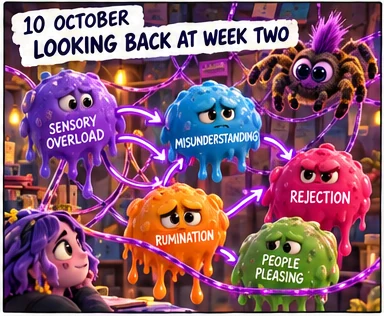
This week has felt different from the first one. The first few Monsters were easier to laugh at. An overflowing inbox, losing track of time, getting stuck between tasks or disappearing down a side quest all have a certain familiarity to them, and sometimes even a kind of charm. This week has gone a little deeper. Sensory overload, misunderstanding, rejection, rumination and people pleasing all sit much closer to the emotional cost of living with an ADHD brain.
What struck me, looking back over these five days, is how often the real difficulty isn’t the first thing that happens. It’s what follows. A noisy room is one thing, but trying to keep functioning after my filtering capacity has run out is another. A misunderstanding is uncomfortable, but the story my brain builds around it can last far longer than the original conversation. Rejection can sting in the moment, then rumination can keep replaying it long after everyone else has moved on. People pleasing can begin as kindness and end with me wondering why I’ve agreed to fourteen things there was never space for in the first place.
None of those patterns exist on their own. They feed each other. If I’m already overloaded, I’m more likely to misread a tone or feel the impact of criticism more strongly. If I’ve felt rejected, I’m more likely to replay the interaction later. If I’ve spent too much time worrying about whether I’ve disappointed someone, I’m more likely to say yes the next time they ask for something. Then the extra commitment adds another demand, which makes overwhelm and sensory overload more likely. It can become a remarkably efficient little system if nobody interrupts it.
That’s probably one of the biggest things I’ve learnt since understanding my ADHD. I used to treat these moments as separate personal failings. I was too sensitive, too intense, too easily distracted, too eager to help, too prone to overthinking. Once I began looking at the patterns rather than judging each individual moment, they started to make much more sense.
The week has also reminded me how important context is. The same environment can be fine one day and too much the next. The same feedback can feel useful when I’m regulated and devastating when I’m already depleted. The same request can be easy to say no to when my diary is calm and almost impossible when the People Pleasing Monster is already telling me that being helpful is part of who I am. ADHD isn’t static. My capacity changes, and so does the amount of support or adjustment I might need.
That variability can be difficult for other people to understand. If I managed something yesterday, why can’t I manage it today? If I enjoyed the busy room last week, why am I wearing headphones now? If I handled criticism perfectly well in one meeting, why did another conversation land so heavily? The answer is rarely that I’ve suddenly become less capable. More often, the conditions are different, even if those differences aren’t obvious from the outside.
This week has made me think a lot about curiosity again. It would be easy to look at any one of these Monsters and reduce it to behaviour. Someone is fidgeting, so they must be distracted. Someone is abrupt, so they must be rude. Someone reacts strongly to feedback, so they must be oversensitive. Someone keeps saying yes, so they must simply be bad at boundaries. Those explanations are neat, but they’re often incomplete.
The more useful question is usually, ‘What is happening underneath this?’ That question has changed how I understand myself, and it has changed how I think about other people too. It creates room for complexity. It lets two things be true at once. I can be highly capable and still become overloaded. I can communicate well and still be misunderstood. I can be confident and still feel rejection deeply. I can be reflective and still get trapped in rumination. I can be generous and still need stronger boundaries.
Barry seems rather pleased with that last bit. He has never been very interested in forcing everything into neat categories. Spiders, apparently, are comfortable with complexity. He just sits in the middle of the web watching the threads move and reminding me that what happens in one part often affects another.
Looking back over Week Two, I think that is the thread I want to carry forward. The Monsters are not isolated problems to defeat one by one. They’re different ways my brain responds to the world around it. Sometimes they’re helpful. Sometimes they’re exhausting. Quite often they’re both at once. Understanding them hasn’t made them disappear; it has simply made them easier to recognise when they arrive and, more importantly, easier to meet with curiosity instead of judgement. Barry says that counts as progress, and for once, I’m inclined to agree.