I like being useful. That probably isn’t a surprising admission from a social worker, and it certainly isn’t a surprising one from someone who has spent a large part of her career building things, solving problems and trying to make systems work better for people. If somebody brings me a problem and I can see a way through it, my instinct is usually to help. If I know the answer, I want to share it. If I can take something difficult and make it easier, there is a very satisfying little part of my brain that immediately wants to get started.
For a long time, I thought that was simply one of my better qualities. In many ways, it still is. Being generous with time, knowledge and energy has created opportunities, relationships and pieces of work that I value enormously. The difficulty is that somewhere along the way, helpfulness can quietly slide into over-responsibility, and I don’t always notice the point where one becomes the other.
It usually starts innocently enough. Somebody asks whether I could have a quick look at something. Of course I can. Another person needs a bit of help untangling a problem. No trouble. There’s a meeting I don’t technically need to attend, but I might be useful. There’s a piece of work that isn’t really mine, but I know how to do it and it will probably be quicker if I just sort it out. None of those decisions feels particularly significant in isolation, but by the time I’ve said yes to all of them, my diary tells a rather different story.
Being the boss adds its own complication because there isn’t always somebody above me to say, ‘You absolutely do not need to take this on.’ I have a lot of freedom to decide what deserves my attention, which is one of the things I love about my work, but freedom and an ADHD brain can be an interesting combination. If something matters, if I can see a solution or if somebody genuinely needs help, there is very little internal resistance between recognising the problem and deciding it has somehow become mine.
The Crew occasionally provide the resistance on my behalf. There are days when I’ll appear with another idea, another project or another thing I think we could improve and be met with the sort of silence that tells me everyone is waiting to see whether I will hear myself. Occasionally somebody will gently remind me that we are already doing quite a lot. They’re usually right. I don’t always enjoy discovering that immediately, but they’re still right.
I’ve had to learn that my enthusiasm can create work for other people as well as for me. A thought that arrives in my head as, ‘Wouldn’t it be interesting if…’ can sound rather different when it lands in somebody else’s inbox from the Chief Executive. I may genuinely be thinking aloud, but that doesn’t mean the person reading it knows that. Understanding that has made me much more conscious of distinguishing between an idea, a suggestion and an actual request, because otherwise my tendency to be enthusiastic can accidentally turn into somebody else’s pressure.
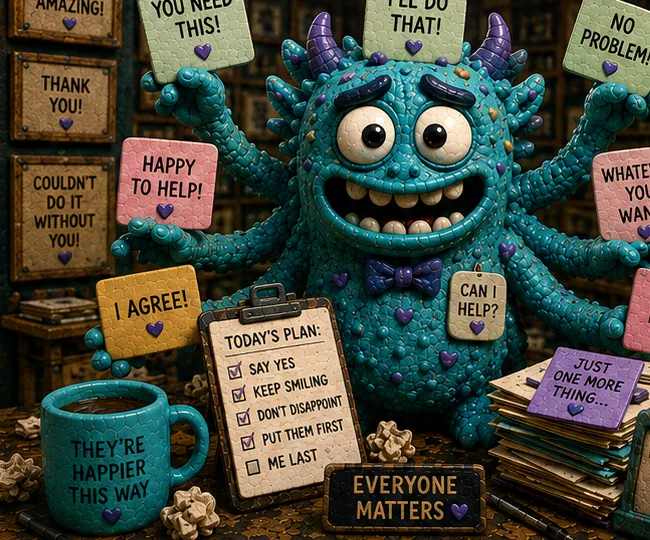
Meet the People Pleasing Monster
The People Pleasing Monster is very comfortable in this territory. She doesn’t look particularly threatening. In fact, she’s rather lovely. She’s helpful, capable and wonderfully reassuring. She reminds me that I know how to fix things and that somebody will be relieved if I say yes. She also knows that saying yes creates an immediate little moment of comfort. The problem has been solved, at least socially. Nobody is disappointed. Nobody has been inconvenienced. I don’t have to sit with the discomfort of saying, ‘I can’t do that,’ or, ‘That isn’t mine to carry.’ Unfortunately, the practical problem hasn’t disappeared. It’s simply been transferred into my diary.
That’s the part I’ve become much more aware of as I’ve got older. People pleasing doesn’t always look like desperately wanting everybody to like you. Sometimes it looks like competence. Sometimes it looks like reliability. Sometimes it looks like being the person who always manages to sort things out. When that identity becomes important, saying no can feel surprisingly uncomfortable because it seems to contradict the version of yourself that everyone has come to expect.
For me, the challenge has never really been whether I care too much about what people think. It’s more complicated than that. I care about being useful, about doing what I said I would do and about not making life harder for other people when I could help. Those are values I want to keep. What I’ve had to learn is that values don’t require me to say yes to everything in order to prove I have them.
Side A and Barry’s B-side
The People Pleasing Monster’s Side A track is Please Please Me by The Beatles, and there is something wonderfully obvious about it. Approval feels good. Being needed feels good. Solving the problem feels good. The Monster is very skilled at concentrating on that immediate reward while quietly leaving tomorrow’s version of me to deal with the consequences.
Barry’s B-side is Go Your Own Way by Fleetwood Mac, which initially struck me as rather dramatic advice for a spider to give. Over time, though, I’ve understood what he means. He’s not suggesting I become detached from other people or stop helping. He’s reminding me that everybody has their own path through the web, and I don’t need to climb onto every thread simply because I can see somebody struggling with it.
That has probably been one of the more difficult lessons for me. Boundaries sound straightforward when they’re written in training materials. In real life, they’re much messier. Sometimes saying no disappoints somebody. Sometimes it means watching a problem remain unsolved for longer than I’d like. Sometimes I have to accept that another person will do something differently from the way I would have done it, and sometimes I have to resist the urge to swoop in and make it easier simply because I can.
I’ve become much more interested in the question of what my yes is costing. If I say yes to another meeting, what am I saying no to? If I take on another piece of work, which existing commitment is losing the time I just gave away? If I solve a problem that really belongs to somebody else, am I actually helping them, or am I preventing them from developing their own way of handling it? Those questions don’t always stop me saying yes, but they make the decision much more deliberate.
The interesting thing is that saying no more often hasn’t made me less helpful. If anything, it has made the help I do give more useful because it is more likely to come from genuine capacity rather than from an automatic reflex. I’ve also learnt that sometimes the most supportive thing I can do is stay alongside somebody while they solve their own problem rather than quietly taking it out of their hands.
I still get this wrong. There are still weeks when I look at my diary and realise the People Pleasing Monster has been taking bookings without consulting me. There are still ideas I become far too enthusiastic about and moments when the Crew have to remind me that having the ability to do something is not, in itself, a compelling reason to do it.
Barry is irritatingly consistent on this point. He keeps reminding me that a strong web depends on each thread carrying the weight it was designed to carry. If one part of the web keeps taking everybody else’s load, eventually it stops being helpful and starts becoming fragile. I’m still someone who likes being useful. I hope I always will be. The difference is that I’m gradually learning that usefulness and endless availability are not the same thing, and that occasionally the kindest answer I can give somebody else, and myself, is not yes.