
Bucket Head: Framing an Adult Social Care Assessment
A reflective activity about how language, context and assumptions can shape what an assessor notices about need, independence, barriers and support.
Start
Same person. Different framing. Different assessment.
Imagine the two extracts in this activity are part of information gathered during an adult social care assessment. The person has not changed. What changes is the language, context and meaning available to the assessor.
Learning objectives
- Notice how deficit-focused language can shape assumptions about need, risk and independence.
- Separate visible task completion from whether everyday life is manageable, reliable and sustainable.
- Explore strengths, coping strategies, sensory needs, executive functioning and environmental barriers without minimising unmet need.
- Identify what further evidence an adult social care assessor would need before reaching conclusions about care and support.

Step 1 of 5
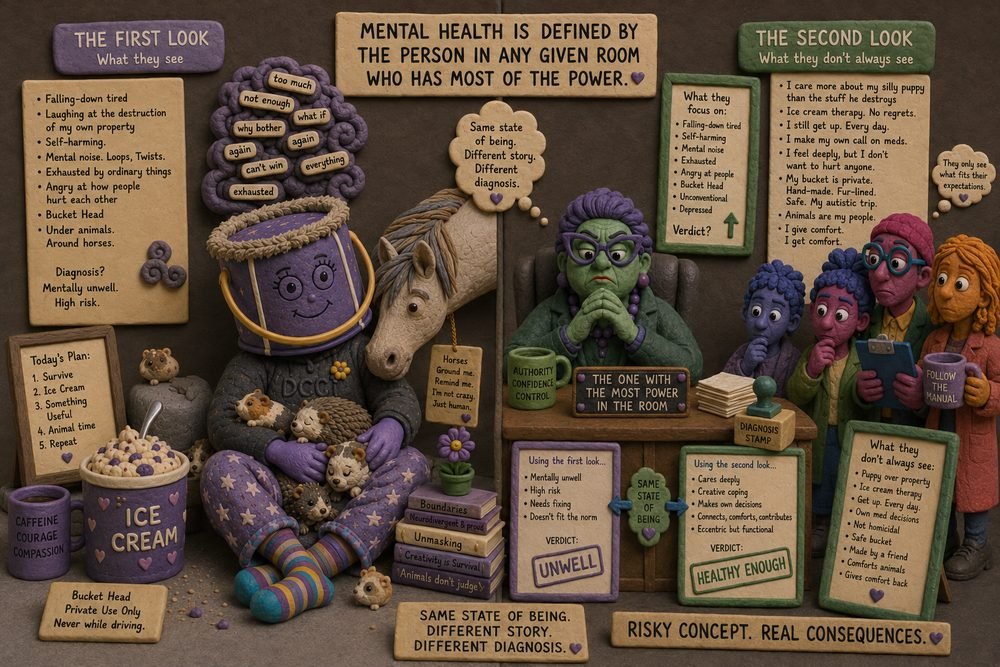
The First Look
Read this as if it appeared in referral information or early assessment notes. Notice what it pulls your attention towards before you know the wider context.
I am self-harming whenever I'm awake; I laugh inappropriately at the destruction of my own private property; I have mental noise of confusing and unhappy thoughts racing in loops and twists; I do not follow conventional wisdom about the use of prescription medications (non-compliance); I find the process of just doing ordinary everyday things exhausting; several times a week I feel deeply depressed and angry at the things I see people doing to one another; sometimes I sit quietly with a specially made bucket on my head; my very favourite place to be is underneath a pile of small animals or wrapped around horses.

Step 2 of 5
The Second Look
Now read the same person with more context. Look for strengths and agency, but also for the effort, adaptations and support that may be making everyday life possible.
To look at it another way however I somehow keep putting one foot in front of the other even though I'm falling-down tired: I'm laughing at the destruction of my own property because I care more about my living, breathing, clumsy, silly puppy than I do about the property he is destroying; I'm self-harming by eating my own body weight in ice cream because I'm presently obsessed with the stuff; even though I have chronic mental noise, I get up and try to do something useful for myself or someone else every damned day. I am confident enough to make my own decisions regarding the use of prescription medications; even though the behaviour of the general public saddens me because it is, to me, so unnecessarily hurtful, I have not become homicidal; my head-bucket was specially made for me by my very good friend — it is comfortably lined with fur and has a face on the outside (so I can appear socially appropriate and have an autistic trip) and I only use the bucket in private — never ever whilst driving. I can both draw comfort from and give comfort to animals almost unconditionally.
Step 3 of 5
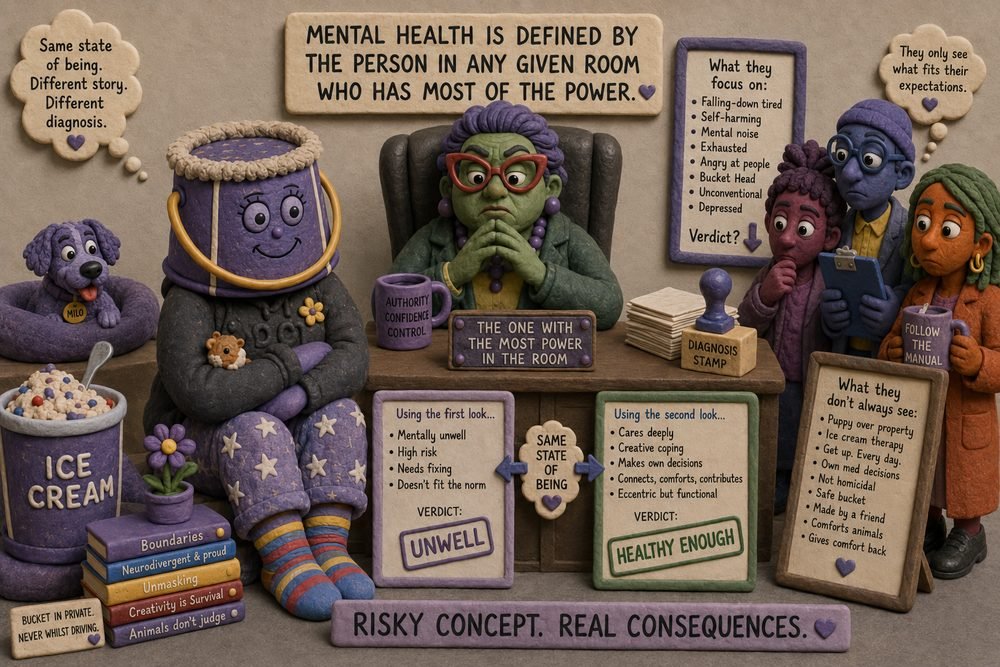
Compare the Framing
Both extracts describe the same person. Compare what each version encouraged you to notice, ask about or overlook.
Discussion prompts
- Did your assessment priorities change between the two extracts?
- Which words shifted your view of independence or need?
- What would you need to know about frequency, prompting, effort, distress and recovery before deciding that an outcome is being achieved?
- How could strengths-based language accidentally minimise support needs if the effort behind apparent independence is not explored?
Step 4 of 5
From Presenting Behaviour to Care and Support Needs
A narrow reading
Stops at what is visible: unusual behaviour, risk language, diagnosis, whether a task was completed, or whether the person can describe what they need. This can overstate incapacity in one place and independence in another.
An adult social care assessment lens
Explores what the person wants to achieve, what happens in ordinary life, what support or adaptations are already doing the heavy lifting, how much effort tasks require, whether things can be done consistently, and the impact on wellbeing when they cannot.
Do not confuse “can sometimes do” with “does not need support”. Context, effort, prompting, recovery and environment are part of the picture.
Step 5 of 5
Make One Assessment Commitment
Choose one concrete thing you will do differently when assessing an autistic or otherwise neurodivergent adult.
Complete
Responses sent.
Your responses have been acknowledged by the trainer workspace.
The practice challenge is to hold strengths and support needs in view at the same time: ask what makes everyday life possible, what it costs the person, and what happens when those supports or conditions are not available.