
CPD practice tool

AGNI Mixed Classification Practice

Use mixed scenarios to decide whether the situation is best understood as consent, objection, or complicated/mixed, then test that classification through the AGNI triangle.

Sort the signal: consent, objection, or complicated

The AGNI approach helps practitioners avoid jumping straight from a label to a legal conclusion. First identify what the person's response appears to be, then test whether the facts support consent, objection, or a more complicated mixed picture.

Use this set for group calibration. The aim is to make the classification visible, then show how the actual arrangements, the person's experience, and the proportionate response either confirm or challenge it.
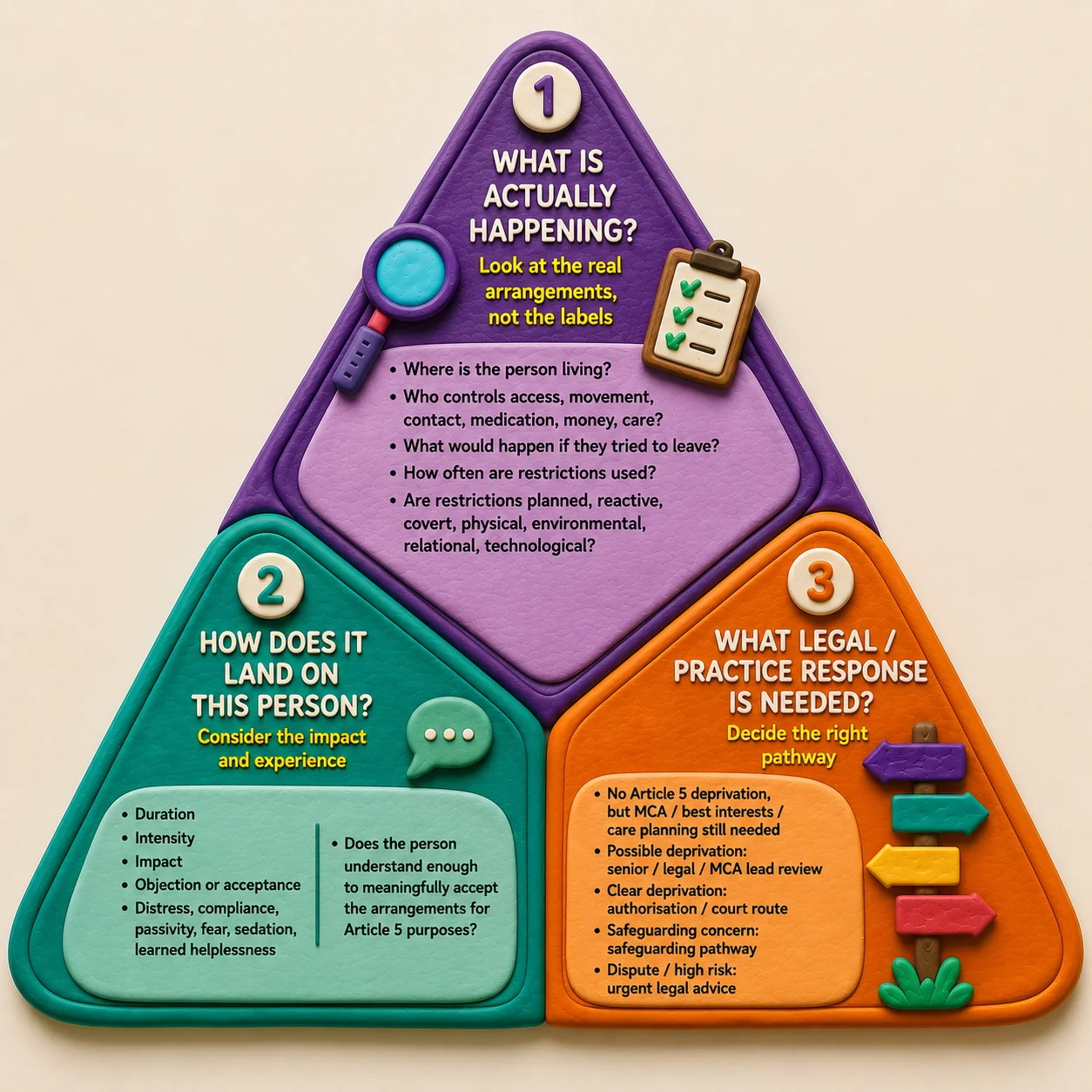
AGNI practice triangle showing three questions: what is actually happening, how does it land on this person, and what legal or practice response is needed.
Step 1 of 6

1. Pick a scenario

Select one case for this run-through. The set deliberately mixes clearer consent, clearer objection, and genuinely complicated presentations so practitioners have to identify the signal before deciding the response.

No scenario selected yet

Choose one of the three options above to load the working facts, pressures, and practice task.

Triangle point 1

What is actually happening?

Describe the real arrangements, not the labels used by services, family, or providers. In borderline cases, small controls can become significant when they combine, repeat, or remove meaningful choice.

Include living arrangements, access, movement, contact, medication, money, care routines, observation, technology, conditions, and informal pressure.

Are restrictions planned, reactive, covert, physical, environmental, relational, technological, conditional, temporary, or drifting into routine?

What would probably happen if the person tried to leave, refused support, used money differently, contacted someone, or made a higher-risk choice?

Name facts you would verify before making a confident judgement.

Triangle point 2

How does it land on this person?

Assess the person-specific impact, then classify the signal. Consent, objection, and complicated/mixed presentations need different practice responses, but the classification must be grounded in what the person says, does, understands, and experiences.

How might the arrangement feel to them day to day?

Include expressed wishes, behaviour, objection, compliance, or signs of distress.

Identify options that could preserve safety while reducing control.

Consent, objection, or complicated?

Choose the classification that best fits the current evidence. Use the next screens to explain the reasoning and any uncertainty.

Impact level for benchmarking

Choose the level your group would use to compare cases.

Triangle point 3

What legal or practice response is needed?

Separate the classification from the legal and practice response, then weigh them back together. Consent may still need review, objection may need urgent escalation, and complicated cases may need more evidence before the route is safe.

Primary response pathway

Pick the best current pathway. Use the rationale box to explain how your consent, objection, or complicated classification affects the route.

Practice actions to take next

Select all that apply for the next 5 working days.

Explain why this pathway is proportionate to the facts and the person's experience.

What would need to change for your conclusion to move up or down a threshold?

Group benchmarking

Calibrate consistency

Use these prompts after individual completion, or in pairs, to compare how people classified the same facts. The trainer can use the captured answers to spot whether variation comes from evidence, threshold, or different readings of consent and objection.

Classification discipline

Did the analysis explain why the case was classified as consent, objection, or complicated?

Person-specific signal

Did the analysis consider words, behaviour, distress, assent, compliance, relationships, culture, and history?

Proportional response

Did the response match the classification without either treating consent as permanent or treating every complication as an objection?

Use 1 for very uncertain and 5 for ready to defend in supervision.

Where do you expect others to classify the same facts differently?

Name the specific consent, objection, complication, threshold, fact, or value judgement the group should compare.

What will you do differently in future analysis or recording?

Complete and send

Review your submission

Your notes will be sent to the trainer dashboard when you use the Complete activity button. Empty fields are not sent.

Before you complete

  • Can someone else see which facts your judgement depends on?
  • Have you made a clear consent, objection, or complicated classification?
  • Have you named how the arrangement lands on the person, including assent, objection, distress, culture, relationships, and history?
  • Have you separated Article 5 analysis from MCA, safeguarding, legal advice, and care planning actions?
  • Have you explained what evidence would change the classification?
  • Have you made the uncertainty clear enough for group benchmarking?