
Explore the Mental Health Act 2025 Hub
Open a section below to move into a dedicated learning screen.
ℹ️ Key Changes to the Mental Health Act
📋 Advance Choice Documents (ACDs)
What are they?
Legally binding documents that allow people with capacity to make advance decisions about their mental health treatment. They enable individuals to specify:
- Preferred treatments and medications
- Treatments they wish to refuse
- Important people to involve in their care
- Support strategies that have worked in the past
- Crisis planning preferences
Legal Status:
Clinicians MUST actively consider ACDs and can only depart from stated preferences if there is clear clinical justification. Any departure must be documented and explained to the patient.
👤 The Nominated Person
What is this role?
The Nominated Person replaces the statutory Nearest Relative role. This person is CHOSEN BY THE PATIENT and acts as their advocate and representative in mental health decisions.
Who can be a Nominated Person?
- Family members
- Friends
- Carers
- Professionals (if the patient has no one else)
Their Rights Include:
- To be informed about the patient's care and treatment
- To be consulted on Care and Treatment Plans
- To request review of detention (Mental Health Review Tribunal)
- To support the patient in exercising their rights
- To access the same information as the patient
🛡️ Independent Mental Health Advocacy (IMHA)
Enhanced Rights:
All detained patients must now be automatically referred to IMHA services, removing the need for patients to request this support.
What IMHAs Do:
- Explain patient rights under the Mental Health Act
- Support patients in understanding information about their care
- Accompany patients to meetings and reviews
- Help patients raise concerns or complaints
- Represent the patient's wishes (not make decisions for them)
Independence:
IMHAs are completely independent from the healthcare provider and can act in the patient's best interests even when this conflicts with treatment decisions.
📋 Statutory Care and Treatment Plans
What Changed?
Care and Treatment Plans are now a legal requirement for all detained patients, not optional recommendations.
They Must Include:
- The patient's diagnosis and needs assessment
- Agreed treatment goals and outcomes
- Specific treatments and interventions
- The patient's role in their care
- The Nominated Person's involvement
- How the plan will be reviewed
- A copy for the patient and their advocates
Co-production:
Plans must be developed collaboratively with the patient, respecting their preferences and including their views. Regular review ensures plans remain appropriate.
⚖️ The Therapeutic Benefit Test
The Change:
The 2025 Act introduces a 'therapeutic benefit' test raising the threshold for detention. It is no longer sufficient that a patient has a mental disorder and needs treatment.
The New Requirement:
There must be evidence that detention will provide genuine therapeutic benefit to the individual patient, taking account of their specific needs and preferences.
Implications:
- Detention cannot be used purely for containment or risk management
- The benefits must outweigh the harms and restrictions of detention
- Community treatment alternatives must be considered first
- Decisions must be documented and reviewable
🌐 Community Treatment Orders (CTOs)
Strengthened Safeguards:
- Clearer criteria for making CTOs
- Regular review requirements (every 3 months initially)
- Enhanced patient and Nominated Person involvement
- Stronger patient rights to challenge orders
- Mandatory IMHA involvement
Patient Rights:
- To understand the reasons for the CTO
- To know their rights under the CTO
- To request a tribunal hearing
- To have advocacy support
- To be involved in treatment decisions
🌍 Culturally Appropriate Care
New Duty:
The Mental Health Act 2025 places specific duties on mental health services to ensure care is culturally appropriate and addresses longstanding inequalities in detention rates, particularly affecting Black, Asian, and minority ethnic communities.
In Practice:
- Services must consider cultural factors in assessment and care planning
- Interpreters and cultural mediators must be available
- Care must be delivered in ways that respect cultural beliefs and practices
- Services must monitor and address disparities in detention
⚖️ Enhanced Tribunal Rights
Improvements:
- Clearer timeframes for tribunal hearings
- Strengthened independent review process
- Automatic referral for patients without advocates
- Enhanced information provision before hearings
- Stronger protections for challenging decisions
For Patients:
These changes ensure patients have regular independent review of their detention and stronger rights to challenge decisions about their care and liberty.
⚖️ The Four Principles of the Mental Health Act 2025
The Mental Health Act 2025 is underpinned by four core principles that represent a fundamental shift in how mental health law should be applied. These principles must guide all decisions made under the Act and are legally binding on all professionals (AMHPs, clinicians, hospital managers, etc.).
1. Choice and Autonomy
The Principle:
Patients should be actively involved in decisions about their care and treatment. Their wishes, feelings, and preferences must be sought and respected wherever possible.
In Practice:
- • Advance Choice Documents must be actively sought and considered
- • Patients can choose their own Nominated Person
- • Patients' views must be genuinely sought and given weight in all decisions
- • Care planning involves shared decision-making, not just consultation
- • Information about choices and options is provided clearly and accessibly
- • Professionals explain their reasoning and respect patient preferences where safe and possible
2. Least Restriction
The Principle:
Any restriction on a person's liberty or rights must be the minimum necessary to achieve the intended purpose, consistent with the person's wellbeing and public safety.
In Practice:
- • Community treatment must be actively considered before detention
- • Informal admission is preferred to compulsory detention where safe
- • Less restrictive options must be exhausted first
- • Restrictions are regularly reviewed and removed as soon as they are no longer needed
- • Discharge planning begins from the moment of admission
- • Use of containment measures (seclusion, restraint) is minimised and justified
3. Therapeutic Benefit
The Principle:
All interventions must have a clear therapeutic aim and be likely to benefit the patient. Detention cannot be used purely for containment or risk management—it must serve the patient's recovery and wellbeing.
In Practice:
- • Every detention decision must be justified by demonstrable therapeutic benefit for that individual
- • Risk management alone is NOT sufficient justification for detention
- • Treatment plans must be tailored to provide therapeutic benefit to the specific patient
- • Regular review ensures therapeutic benefit continues throughout detention
- • If therapeutic benefit is no longer achievable, detention should end
- • This raises the threshold for detention significantly compared to previous legislation
4. The Person as an Individual
The Principle:
Patients must be treated with dignity and respect, recognising their unique attributes, background, and experiences. Care must be personalised and culturally appropriate.
In Practice:
- • Individual circumstances, background, and preferences are actively considered
- • Cultural beliefs and practices are respected in care planning and delivery
- • Interpreters and cultural mediators are provided where needed
- • Care is tailored to the person, not standardised approaches applied to everyone
- • Particular attention to needs of people with autism, learning disabilities, and minority ethnic backgrounds
- • Dignity is maintained in all interactions and environments
📊 Principles Comparison: 1983 Act vs 2025 Act
Mental Health Act 1983 Principles
The Seven Guiding Principles (non-statutory guidance):
- Purpose: Respect for purposes of the Act
- Least Restriction: Minimise unnecessary restrictions
- Respect for Rights: Recognise rights and freedoms
- Participation: Involve users and carers
- Effectiveness: Deliver services effectively
- Efficiency: Deliver services efficiently
- Non-Discrimination: Treat people fairly regardless of characteristics
⚠️ Important: These were informal guidance principles. Services were NOT legally required to follow them, and they were not binding in law.
Mental Health Act 2025 Principles
The Four Core Principles (legally binding):
- Choice and Autonomy: Patients actively involved in decisions about their care
- Least Restriction: Any restriction must be minimum necessary for wellbeing and safety
- Therapeutic Benefit: All interventions must have clear therapeutic aim and benefit
- The Person as an Individual: Treated with dignity, recognising unique background and experiences
✓ Legally Binding: All professionals (AMHPs, clinicians, hospital managers) MUST have regard to these principles. Decisions must record how principles have been considered. Tribunals and courts will expect evidence that principles have been followed.
Key Shift 1: Legal Status
1983 Act: 7 principles, non-statutory guidance, optional consideration
2025 Act: 4 principles, legally binding, must guide ALL decisions
Decisions must document how principles have been considered.
Key Shift 2: Patient Autonomy
1983 Act: Participation mentioned but professional judgment primary
2025 Act: Choice and autonomy a core principle, patients actively involved
Wishes, feelings, and preferences must be sought and respected.
Key Shift 3: Therapeutic Justification
1983 Act: No explicit therapeutic benefit requirement
2025 Act: Therapeutic benefit is a core principle
Risk management alone is NOT sufficient. All interventions must have clear therapeutic aim.
Key Shift 4: Accountability
1983 Act: Limited scrutiny of principles adherence
2025 Act: Strong legal accountability, documented in decisions
Tribunals will review adherence to principles as part of all hearings.
📋 How the Principles Work in Practice Under the 2025 Act
1. Legal Duty:
All professionals (AMHPs, clinicians, hospital managers) MUST have regard to these principles when making decisions under the Act. This is a legal requirement, not optional.
2. Documentation:
Decisions—especially those involving restriction or compulsion—should clearly record HOW the principles have been considered and applied. If departing from a principle, the reasoning must be documented.
3. Tribunal & Court Review:
Mental Health Review Tribunals and courts will expect to see evidence that the principles have been followed in decision-making. Breach of principles can be grounds for challenging decisions.
4. Practice Examples:
- Every detention decision must be documented with how therapeutic benefit has been assessed
- Advance Choice Documents must be actively sought and considered, with reasons if not followed
- Care plans must reflect how patient autonomy and choice have been incorporated
- Less restrictive alternatives must be documented as considered and the reasons if rejected
💭 The Impact: What This Means in Practice
For Patients & Service Users
The shift to legally binding principles means:
- ✅ Your preferences MUST be considered, not just listened to
- ✅ Your autonomy is protected even during detention
- ✅ Detention can only happen if it will genuinely help you recover
- ✅ You have a right to an advocate from the start
- ✅ Decisions can be challenged if principles aren't followed
- ✅ Better protection from being detained for containment alone
For Mental Health Professionals
The impact on practice is significant:
- ✅ Must actively seek Advance Choice Documents
- ✅ Decision-making becomes more complex and time-intensive
- ✅ Need to document how principles guided decisions
- ✅ Must consider alternatives before detention
- ✅ Therapeutic benefit assessment required for every detention
- ✅ Higher threshold means some previously detained patients won't be
- ✅ Community provision must be significantly expanded
For NHS Services & Systems
Organisational changes required:
- ✅ Training all staff to apply the principles
- ✅ Creating systems to document adherence
- ✅ Expanding community mental health services
- ✅ Audit and monitoring of principle adherence
- ✅ Better data collection on outcomes and equity
- ✅ Potential increase in tribunal hearings
- ✅ More partnership working with advocacy services
For Detention Rates & Equity
Expected outcomes:
- 🔍 Likely reduction in overall detention numbers due to higher therapeutic benefit threshold
- 🔍 Targeted reduction in disparities – detention rates for BAME individuals should fall
- 🔍 New pathways for people with autism and learning disabilities
- 🔍 Shift from detention to community-based alternatives
- 🔍 Greater scrutiny of decisions affecting protected groups
- 🔍 Better outcomes through more therapeutic, person-centred care
🤔 Reflection Point:
How do you think these principles will change your practice? What will be hardest to implement? Where do you see the benefits?
Consider recording your thoughts in the Reflection section.
🔄 What Changed? Old vs New Act
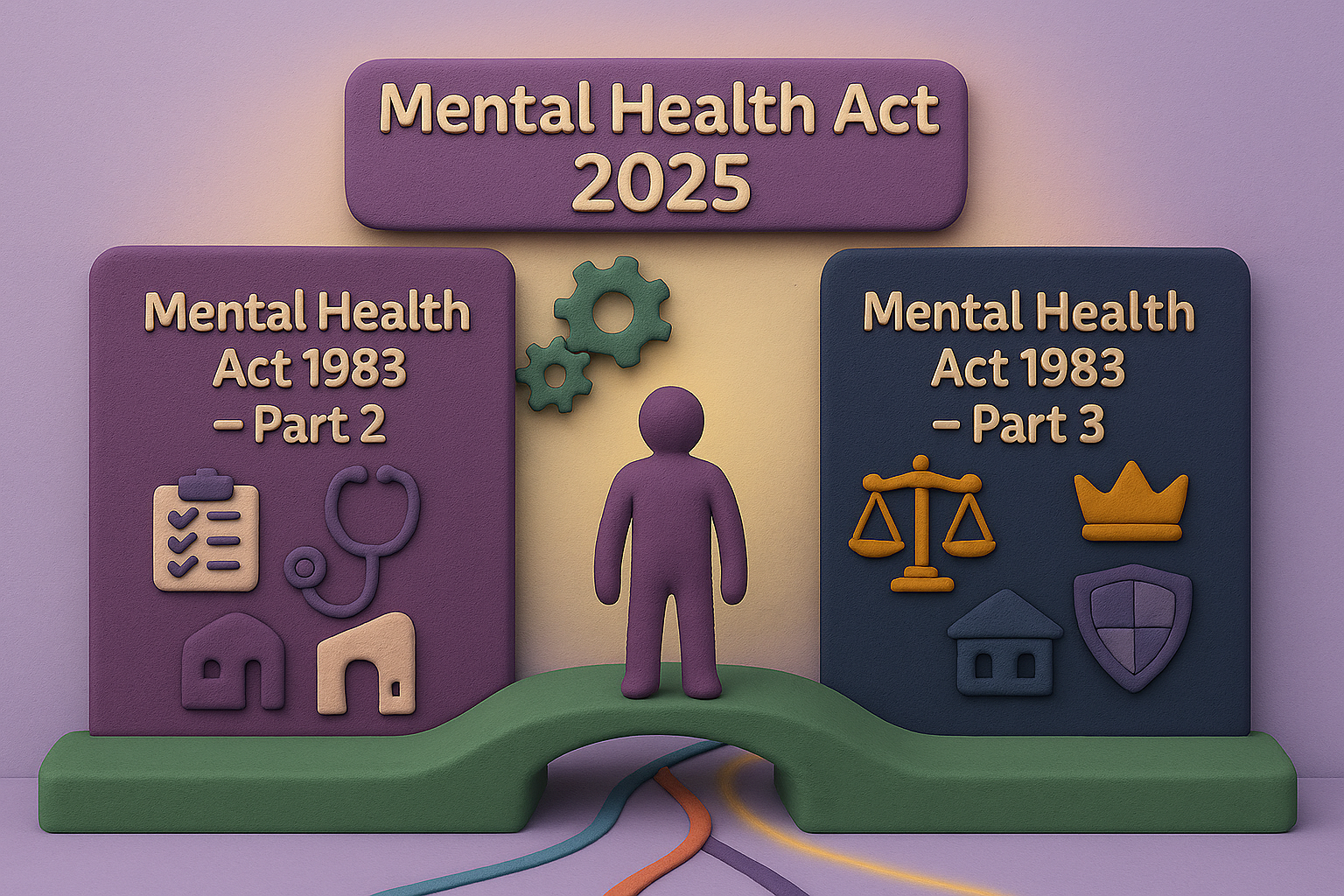
| Area | Previous Mental Health Act 1983 | Mental Health Act 2025 |
|---|---|---|
| Advocate Role | Nearest Relative (automatic, often family) | Nominated Person (patient-chosen) |
| Advance Decisions | Limited rights, easily overridden | Legally binding ACDs, must consider & document reasons if overridden |
| Advocacy Access | Patient must request IMHA services | Automatic referral to IMHA for all detained patients |
| Care Planning | Care plans recommended but not statutory | Statutory Care and Treatment Plans required, must be collaborative |
| Detention Threshold | Mental disorder + treatment needed + safety concerns | Therapeutic benefit test - detention must provide genuine therapeutic benefit |
| CTOs | Limited review requirements | Strengthened safeguards, regular review, enhanced patient involvement |
| Tribunal Rights | Review available but not automatic | Enhanced rights with clearer timeframes and stronger protections |
| Cultural Considerations | Limited specific requirements | Explicit duty to ensure culturally appropriate care and address inequalities |
| Patient Autonomy | Limited patient control over decisions | Significantly enhanced - choices about advocates, treatment, and planning |
| Rights Communication | Information given on request | Automatic provision, clear explanation, IMHA referral as standard |
📊 Summary of Key Improvements
For Patients
- ✓ Greater choice in who advocates for them
- ✓ Legally recognised advance preferences
- ✓ Automatic access to independent advocacy
- ✓ Stronger voice in care planning
- ✓ Better protection from unnecessary detention
For Services
- ✓ Clearer detention criteria
- ✓ Stronger legal framework
- ✓ Better documentation requirements
- ✓ Duty to address inequalities
- ✓ Enhanced accountability
📅 Implementation Timeline (2025-2035)
The Mental Health Act 2025 will be implemented over 10 years in phases. Only the date of 18 February 2026 (Part 3 Amendments) is confirmed. All other dates are speculative and provisional.
2025: Royal Assent & Planning
Initial phase
Royal Assent for the Mental Health Act 2025 and initial planning:
- ✓ Royal Assent received for the Mental Health Act 2025
- ✓ Initial planning and communication by DHSC, NHS England, and local authorities
- ✓ Setting up implementation structures and working groups
- ✓ Early engagement with stakeholders and service users
2026: Code of Practice & Legislative Development
Confirmed: Part 3 Amendments - 18 February 2026
Drafting, consultation, and early preparatory work:
- ✓ Drafting and consultation on new Code of Practice (involvement of lived experience, carers, professionals, Parliament)
- ✓ Development of secondary legislation and regulations
- ✓ 📅 Part 3 Amendments (18 February 2026)
- ✓ Early preparatory work by local authorities, NHS Trusts, and ICBs
- ✓ Policy review and training plans development
- ✓ Systems assessment and IT infrastructure planning
2027: Code Publication & Workforce Training
Expected late 2026 or early 2027
Publication and initial training begins:
- ✓ Publication of the new Code of Practice (expected late 2026 or early 2027)
- ✓ National workforce training programme launched
- ✓ Early reforms commenced that require limited workforce expansion
- ✓ Supervised discharge changes implemented
- ✓ Development of guidance and support materials
2027/28: First Major Reforms
Core changes expected
First major set of reforms across mental health services:
- ✓ Nominated Person replaces Nearest Relative
- ✓ New detention criteria introduced (higher threshold for risk and necessity)
- ✓ Advance Choice Documents become available nationwide
- ✓ Changes to Care and Treatment Plans and Dynamic Support Registers
- ✓ New rights for people with autism and learning disability
- ✓ Enhanced safeguards for vulnerable groups
- ✓ Ongoing staff training and system changes
2028–2030: Progressive Expansion
Phased implementation as capacity builds
Further reforms phased in as workforce and community services expand:
- ✓ Increased frequency of Mental Health Tribunals (requires more judges and clinicians)
- ✓ Full rollout of new advocacy rights for informal patients
- ✓ Expansion of community infrastructure for learning disability and autism
- ✓ Enhanced IMHA services across all regions
- ✓ Comprehensive community treatment order implementation
- ✓ Ongoing evaluation and feedback systems established
- ✓ Regular reporting to Parliament and stakeholders
2030–2035: Full Implementation & Bedding In
All provisions fully operational
Final phase bringing all reforms to completion:
- ✓ Full implementation of all reforms across mental health services
- ✓ All new duties, rights, and safeguards fully in force
- ✓ Workforce and community services at required capacity
- ✓ Extensive outcome data and impact evaluations completed
- ✓ Code of Practice reviewed and updated based on experience
- ✓ Evidence-based adjustments and continuous improvements
- ✓ Ongoing monitoring to ensure equitable implementation
By 2035: 10-Year Horizon
Fully embedded transformation
Mental Health Act 2025 fully embedded in practice:
- ✓ All new provisions, rights, and safeguards established in law and practice
- ✓ Workforce trained and competent across all settings
- ✓ Community infrastructure robust and accessible
- ✓ Measurable improvements in patient outcomes and experience
- ✓ Reduced disparities in mental health detention rates
- ✓ Strong advocacy and safeguarding infrastructure
- ✓ Ongoing evaluation and continuous improvement processes embedded
🗓️ Key Confirmed & Speculative Dates
✓ CONFIRMED
18 February 2026
Part 3 Amendments
? SPECULATIVE
Late 2026 / Early 2027
Code of Practice Published
? SPECULATIVE
2027/28
First Major Reforms
? SPECULATIVE
By 2035
Full Implementation
⚠️ Important Notes
Only 18 February 2026 (Part 3 Amendments) is officially confirmed. All other dates are speculative and provisional based on typical implementation timescales.
This timeline may be subject to change based on:
- Parliamentary proceedings and any amendments
- Resource availability in NHS services
- Training and workforce preparation readiness
- Stakeholder consultation findings
- Emerging implementation challenges
- Government priorities and budget allocations
For the latest updates: Check the Department of Health & Social Care website, NHS England updates, and your local NHS guidance.
Quarterly Updates
📰 Watch this space for updates!
These updates track what actually changed in early 2026, what is now in force, and what is still planned for later phases of implementation.
Easy Read Guide published
DHSC published an easy-read guide to the Mental Health Act 2025, explaining the reforms in accessible language for service users, families, and stakeholders.
Hub relevance: useful as a learner and service-user resource in the information section.
NHS sector briefing: what you need to know
NHS Confederation and partners highlighted the phased rollout, the need for community capacity, and the expectation of a future Code of Practice consultation.
Hub relevance: helps learners understand which reforms are active now and which remain pending.
First commencement provisions took effect
The first MHA 2025 provisions came into force, mainly affecting forensic and Part III practice. This included new powers around conditional discharge with deprivation of liberty conditions, broadened transfer powers from custody, and updated tribunal rights for those cases.
- Conditional discharge with DoL conditions: allows liberty-restricting community discharge conditions for a small number of restricted patients where needed for public protection.
- Transfers from custody: broadens who can be moved from custody to hospital, including some immigration detainees and children in youth detention settings.
- Tribunal access: introduces more explicit review routes and automatic referrals for patients under community DoL conditions.
Supervised discharge guidance published
Official guidance explained how to use the new supervised discharge power, including criteria, approval routes, care planning, risk management, and tribunal oversight.
Hub relevance: especially important for AMHPs, responsible clinicians, and forensic practice learning.
Code of Practice development began
Preparatory work started for a revised Mental Health Act Code of Practice, including lived experience engagement and planning for consultation.
Hub relevance: learners should know current code guidance still applies for now, but updated guidance is being developed.
Commencement No.1 Regulations made for 6 April 2026
Secondary legislation confirmed two further provisions would come into force on 6 April 2026:
- Section 51: Human Rights Act duties extended to certain private providers delivering NHS-funded mental health care or aftercare.
- Section 52: a review duty created around CQC notifications where children are admitted to adult mental health wards.
What is active now vs later
As of Q1 2026, only a narrow set of MHA 2025 provisions are active. Most major reforms are still future changes.
Active in early 2026
- Conditional discharge with DoL conditions
- Broadened custody-to-hospital transfers
- Updated tribunal oversight for DoL cases
- Section 51 and 52 changes from 6 April 2026
Still to come later
- Nominated Person reforms
- New detention criteria and serious harm threshold
- Statutory care and treatment plans
- Wider autism / learning disability changes
📖 Interactive Scenarios
Work through these realistic scenarios to understand how the Mental Health Act 2025 applies in practice.
🃏 Memory Card Game
Match the Mental Health Act 2025 terms with their correct definitions. Click cards to reveal them.
🎉 Congratulations!
You completed the memory game in 0 moves!
📚 Flashcards
Click each card to reveal the explanation. Review all key concepts from the Mental Health Act 2025.
Click to reveal
Term
Definition
✅ Self-Assessment Checklist
Tick off each item as you feel confident in your understanding of these key areas.
📝 Knowledge Test
Test your understanding of the Mental Health Act 2025. You'll need to answer 10 questions.
Question text here
🎉 Quiz Complete!
Well done, User!
Score: 0/10
💭 Reflection
Take time to reflect on your learning. Complete the prompts below and print your reflection summary.
✅ Activity Complete
Your responses have been sent to the DCC-i Portal for trainer review.
You can now return to the lesson page.