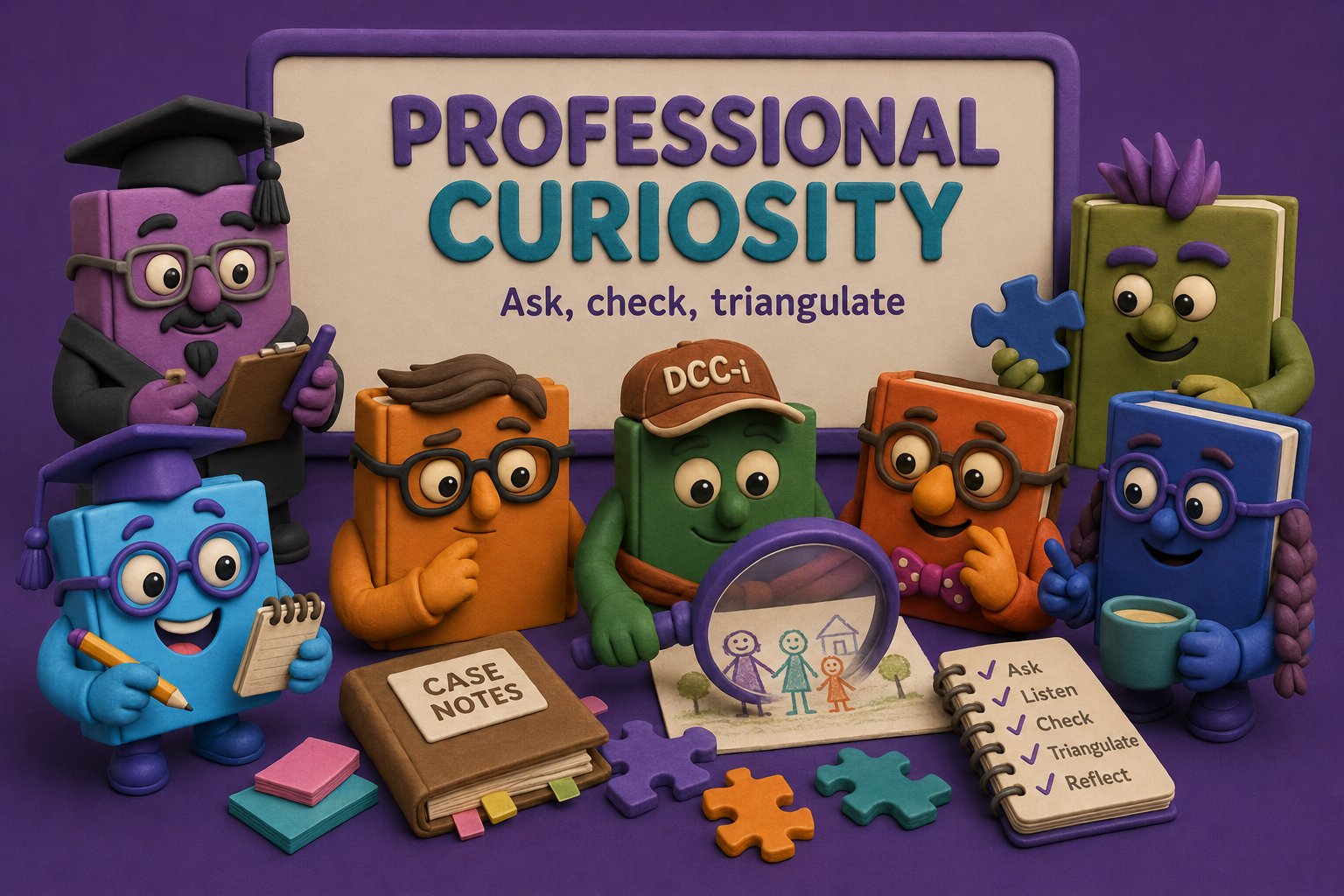
Professional curiosity means actively exploring what is happening for a child, adult or family instead of accepting the first explanation, the loudest account or the most comfortable hypothesis at face value.
Look
Notice presentation, relationships, home conditions, injuries, attendance, behaviour, fear, silence, avoidance and changes over time.
Listen
Hear the child or adult's own words where possible. Pay attention to what is not said, who answers for whom, and whose voice is missing.
Ask
Use direct but respectful questions. Ask about inconsistencies, daily routines, relationships, safety, worries and what help would make a difference.
Check
Compare accounts with records, observations and other professional information. Curiosity becomes safeguarding practice when it is evidenced.
Triangulate
Build the whole picture across agencies, family networks, history and current presentation. Patterns matter more than isolated incidents.
Escalate
Use supervision, consultation and escalation routes when risk remains unclear, disagreement persists or a child may be suffering significant harm.
Practice caution: Curiosity must be anti-discriminatory and proportionate. It should challenge bias as well as risk. Do not treat culture, poverty, disability, neurodivergence, immigration status or family form as evidence of harm. Do ask how those factors shape need, access to help, power and safety.
Professional curiosity sits inside ordinary safeguarding law and guidance. It supports lawful, proportionate decision-making by improving the quality of information, analysis and challenge.
Children Act 1989
- Section 17: child in need assessment and support.
- Section 47: enquiries where there is reasonable cause to suspect significant harm.
- Section 31: threshold for care and supervision orders.
Working Together 2026
The current statutory guidance keeps multi-agency safeguarding at the centre of practice. Curiosity is operationalised through information sharing, child-centred assessment, strategy discussion, review, escalation and learning from serious incidents.
Education and health roles
KCSIE, safeguarding health guidance and local procedures all rely on staff noticing concerns, recording clearly, sharing information and following up when an explanation does not fit the child's presentation.
Human rights and proportionality
Curiosity does not remove the need for lawful thresholds, procedural fairness, Article 8 proportionality and careful recording. Better questions should support fairer decisions, not shortcut them.
Reviews repeatedly show that professional curiosity is not just an individual skill. It depends on supervision, workload, culture, leadership, information systems and multi-agency confidence.
2011The Munro Review
Munro argued for a child-centred system that enables professionals to make sound judgements rather than simply comply with process. For this pack, the key learning is that curiosity needs time, reflective supervision, critical reasoning and freedom to exercise professional judgement.
GOV.UK: Munro final report
2020Serious case reviews 1998 to 2019
The triennial overview identifies recurring review themes across two decades, including assessment quality, information sharing, seeing the child and understanding family history. Use it to show that curiosity is not a new slogan; it is a long-standing learning theme.
GOV.UK: SCR analysis
2022Arthur Labinjo-Hughes and Star Hobson
The national review identified weaknesses in information sharing and seeking, lack of robust critical thinking and challenge, and insufficient understanding of children's daily lives. It is a central resource for converting professional curiosity into multi-agency child protection practice.
GOV.UK: national review
2022-23Child Safeguarding Practice Review Panel annual report
The Panel warns that lack of professional curiosity is a recurring theme, but that the phrase is often used without enough analysis of why practitioners struggle to be curious. That matters for supervision: ask about conditions, not only individual omission.
Panel annual report 2022 to 2023
2024Child sexual abuse in the family environment
The Panel's thematic review, "I wanted them all to notice", is relevant because it stresses noticing, hearing, asking and making sense of signs that can otherwise remain hidden.
Panel thematic review
2024Serious youth violence
The national joint targeted area inspection report links professional curiosity to understanding children's needs in serious youth violence, especially in emergency, health and police responses.
GOV.UK: serious youth violence report
The purpose of curiosity is to improve judgement. These prompts can be used in home visits, assessments, MASH discussions, strategy meetings, supervision, audits and CPD reflection.
Ten curiosity questions
- What is the child's day-to-day life like?
- Have I seen and spoken with the child alone where appropriate?
- Whose account am I relying on most?
- What evidence supports this explanation?
- What does not fit?
- What does history add to today's concern?
- Who else knows part of the picture?
- What would I ask if I were less worried about causing offence?
- What bias might be shaping my judgement?
- What needs escalation today?
Good recording
- Record what was seen, heard and asked.
- Separate fact, professional judgement and untested account.
- Note inconsistencies and how they were explored.
- Record the child's voice and lived experience.
- Explain why information was or was not shared.
- Record supervision and escalation decisions.
When curiosity is most needed
- Repeated low-level concerns.
- Unseen or unheard children.
- Disguised compliance or hostile engagement.
- Domestic abuse, coercive control or adult fear.
- Neglect, home conditions or missed appointments.
- Non-accidental injury, bruising or inconsistent explanations.
- Extra-familial harm, exploitation, gangs and online risk.
- Professional disagreement or threshold uncertainty.
Curiosity with families
- Be transparent about worries and duties.
- Use plain, respectful language.
- Ask direct questions without shaming.
- Do not let empathy for adults eclipse the child's safety.
- Test explanations with evidence rather than tone.
- Keep asking what support would reduce risk.
Supervision tip: Replace "why did the practitioner lack curiosity?" with "what stopped curiosity here?" That opens discussion about time, confidence, fear, supervision, bias, hierarchy, access to records, thresholds, emotional impact and professional challenge.
This section retains the Thurrock focus and links professional curiosity to local safeguarding learning, routes and review themes. Practitioners should always check the live Thurrock LSCP pages for current procedures and training access.
Local partnership and resources
Thurrock LSCP publishes local safeguarding resources, training information, seven-minute briefings and review learning. The LSCP seven-minute briefing page includes a Professional Curiosity briefing.
Thurrock LSCP seven-minute briefingsReview themes named locally
Thurrock scrutiny minutes record review themes of information sharing, professional curiosity, thresholds and escalations, and working with resistance. These are useful anchors for local supervision and audit.
Thurrock committee recordPublished review learning
Thurrock LSCP's public review page includes serious youth violence and gang-related activity learning, Ashley and Shae, Leo, Frankie, and Sam and Kyle materials. Use these to test how curiosity applies in local contexts.
Thurrock LSCP published reviewsSigns of Safety
Thurrock describes Signs of Safety as a way to help children and young people talk about worries and what helps keep them safe. This aligns well with child-centred curiosity when it is used alongside evidence, challenge and escalation.
Thurrock Signs of Safety
Thurrock supervision prompts
- What local review theme does this case most resemble: information sharing, professional curiosity, thresholds and escalation, or working with resistance?
- Have we used the local consultation, MASH, escalation or dispute-resolution route at the right time?
- What would the child say is the main worry, and have we checked that directly?
- Which local partner may hold information that would change our analysis?
The exact phrase "professional curiosity" appears more often in safeguarding reviews, coroner reports and practice guidance than in leading appellate case law. The cases below are included because they support the legal habits behind curious safeguarding: evidence, thresholds, proportionality, competent challenge and child-centred analysis.
Gillick v West Norfolk and Wisbech AHA [1985] UKHL 7
Useful for considering young people's understanding and decision-making capacity. Curiosity should include what the young person understands, wants and fears.
BAILIIRe H (Minors) [1996] AC 563
Important for the balance of probabilities in child protection fact-finding. Serious allegations still require evidence and careful reasoning, not assumption.
Judgment PDFRe B (A Child) [2013] UKSC 33
Proportionality is central when the state intervenes in family life. Curiosity supports, but does not replace, lawful threshold and welfare analysis.
UK Supreme CourtRe B-S (Children) [2013] EWCA Civ 1146
Requires proper evidence, option analysis and reasoning, especially in adoption and placement decisions. This is curiosity translated into formal analysis.
Judgment PDFRe J (Children) [2013] UKSC 9
Relevant where previous findings, uncertain perpetrator issues or patterns inform future risk. Avoid mechanical assumptions and analyse present evidence.
UK Supreme CourtRe E [2017] EWFC 101
A useful practice-learning judgment on multi-agency child protection, medical evidence, checking assumptions and the consequences of weak communication. It is often discussed as an example of why respectful professional challenge matters.
Transparency Project summaryPoole Borough Council v GN [2019] UKSC 25
Important for public authority liability. It does not remove statutory safeguarding duties, but it helps practitioners distinguish legal liability from safeguarding responsibility.
UK Supreme CourtHXA v Surrey CC; YXA v Wolverhampton CC [2023] UKSC 52
Further Supreme Court authority on local authority duties of care in child protection contexts. Useful for legal literacy, not as a reason to narrow safeguarding practice.
UK Supreme Court
Reflection questions
- Where might I be accepting an explanation too quickly?
- What would respectful uncertainty look like in my role?
- How do I evidence the child's lived experience?
- When did I last use escalation because the picture was incomplete?
- What helps me challenge another professional well?
- What organisational barriers make curiosity harder in my setting?
30-day action plan
- Choose one current case for a curiosity audit.
- Bring one "what does not fit?" question to supervision.
- Review local escalation guidance.
- Check one record for separation of fact, analysis and account.
- Share one review-learning link with a colleague.
- Identify one bias-risk in your team's usual decision-making.
CPD evidence note: Suggested evidence: date completed, sections reviewed, one source opened, one practice insight, one supervision discussion, and one action taken in practice or team learning.