
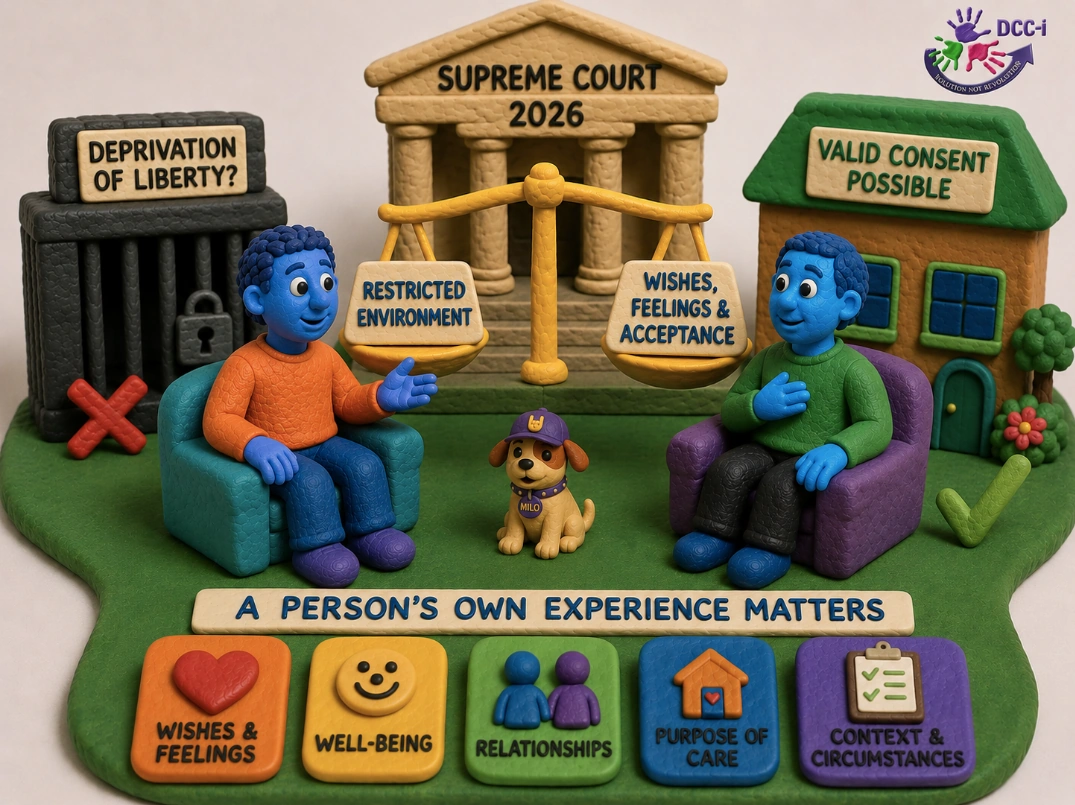
01 · Executive summary
Core message for practice
Informal admission after the Supreme Court decision is not a broad permission to treat quiet, compliant or recently detained patients as outside Article 5. In mental health hospital settings, especially after s.2 detention or where capacity and acceptance are unclear, practitioners should start from a high-alert position: there may be a deprivation of liberty unless there are specific, evidenced reasons why not.
Practice correction: “Least restrictive” is not a mantra. Informal admission may sound less restrictive than detention, but if the person cannot realistically leave, does not understand the arrangement, lacks a route to challenge, or is being managed under close control, the label may conceal coercion rather than reduce it.
02 · Supreme Court shift
What has changed — and what has not?
| Issue | Earlier framing | Revised practice focus |
|---|---|---|
| Legal threshold | The Cheshire West acid test: continuous supervision and control, and not free to leave. | A more contextual assessment of the type, duration, effect and manner of implementation of restrictions. |
| Starting point in MH hospital | Sometimes treated as a balanced judgement between informal admission and deprivation of liberty. | Start from Article 5 risk unless specific evidence shows why the person is not deprived of liberty in the actual circumstances. |
| Capacity and acceptance | Lack of capacity was often treated as meaning informal admission could not be valid. | Basic understanding and acceptance may be relevant, but must be evidenced and revisited. Silence, passivity or settled presentation are not enough. |
| Post-detention cases | Discharge from s.2 could be treated as a fresh informal admission decision. | Recent compulsory detention raises the caution level. Practitioners should record what has materially changed and why safeguards are no longer required. |
| Risk | Clearer legal route, but potentially wider use of DoLS/Court scrutiny. | More room for judgement, but greater risk of poor reasoning, assumed consent, missed objection or safeguard loss. |
03 · Article 5 discipline
Default to scrutiny, not reassurance
The practical question is not “can we describe this as informal?” The question is “has the state provided a lawful basis, safeguards, review and a route to challenge for the actual level of control being exercised?”
1
Positive obligations
Where the person is confined in substance and valid consent is absent or doubtful, Article 5 requires legal visibility. The state cannot avoid safeguards by relying on benign language.
2
Hospital reality
Mental health admission often involves locked environments, observation, medication, leave limits and professional control. Those features should raise the question of deprivation of liberty, not soothe it away.
3
Evidence can displace risk
There may be cases where the person is genuinely accepting, restrictions are light, and no DoL arises. But the evidence has to do the work. The label “informal” cannot.
Do not let “least restrictive” become least safeguarded. The least restrictive route is not always the route with the fewest forms. It is the route that lawfully matches the person’s actual situation while preserving rights, review and challenge.
04 · Post-s.2 caution
Recent s.2 detention changes the analysis
The move from s.2 to informal status is not a neutral reset
If compulsory powers were needed shortly before, the bar should be high before concluding that the person is now merely “settled”, not deprived of liberty, and needs neither s.3 nor DoLS / other Article 5 safeguards.
?
What has materially changed?
- Has the person’s mental state changed?
- Has risk changed?
- Have restrictions reduced?
- Has understanding improved?
- Is acceptance now meaningful and stable?
!
What should not drive the decision?
- A wish to avoid s.3 consequences.
- Administrative convenience.
- The person becoming quieter on the ward.
- The assumption that “settled” means free.
- A thin note that they are “not objecting”.
Recording prompt: if the person has recently been detained under s.2, record why the compulsory framework is no longer required, what has changed since detention, whether the person is genuinely accepting admission and treatment, what restrictions remain, and why Article 5 safeguards are not required.
05 · Capacity, consent and acceptance
The three questions that now matter
A
Understanding
- Does the person understand where they are?
- Do they understand the purpose of admission?
- Do they understand key restrictions, including locked doors, medication, observation and leave?
- Do they understand any realistic alternative?
B
Acceptance
- Are they genuinely accepting the arrangements?
- Could they realistically say no?
- Are they passive, anxious, suggestible, sedated, fearful or resigned?
- What does their behaviour mean in context?
C
Ongoing review
- Consent is not a one-off admission event.
- Acceptance may change once the person experiences the ward.
- Review is triggered by distress, refusal, increased restriction or attempts to leave.
Practice caution
Not objecting is not the same as meaningful consent. Acceptance must be evidenced, supported and revisited.
06 · Admission routes
Voluntary, informal or formal detention?
| Status | What it indicates | Practice caution |
|---|---|---|
| Voluntary admission | Clear, capacitous decision-making and active agreement to admission. | Do not use “voluntary” casually where understanding is limited, pressure is present, or the person cannot realistically leave. |
| Informal admission | May be defensible where there is evidence of basic understanding, meaningful acceptance, no objection, proportionate restrictions and active review. | This is the risky grey area. It needs evidence, not assumptions. The more hospital control there is, the harder the reasoning has to work. |
| Formal detention / DoLS / Court route | Required or strongly indicated where there is objection, significant risk, lack of acceptance, ongoing confinement, or need for formal safeguards. | Do not avoid formal routes because the person is quiet, confused, difficult to read or superficially settled. |
RestrictionsUnderstandingAcceptanceObjectionRecent detentionSafeguardsReview
07 · Decision flow
A practical route through the grey area
Describe the actual arrangement Include ward type, locked doors, observation, medication, leave, limits, duration and practical impact.
Start with Article 5 risk In mental health hospital settings, do not treat the scales as even. Ask what specific evidence shows there is no deprivation of liberty.
Check whether this is a post-s.2 case If so, record what has materially changed since compulsory detention and why formal safeguards are no longer required.
Check basic understanding What does the person understand about where they are, why they are there, and what restrictions apply?
Explore acceptance Are they genuinely accepting, or merely compliant, passive, fearful, sedated, suggestible or resigned?
Look for objection Objection may be verbal, behavioural, emotional, situational or based on past and present wishes.
Choose the safeguarded legal route Decide whether voluntary, informal, MHA detention, DoLS/Court or escalation best fits the evidence and safeguards needed.
Review after admission Reassess if restrictions increase, distress emerges, treatment is refused, family disagree, or the person seeks to leave.
08 · England and Wales
Advocacy changes the safeguard picture, not the Article 5 test
W
Wales
There may be more room for a carefully safeguarded informal admission because IMHA support is available to informal mental health patients. That can help evidence understanding, acceptance, challenge and review.
But advocacy does not itself remove a deprivation of liberty. The real restrictions, acceptance and route to challenge still have to be analysed.
E
England
Where equivalent IMHA access is not yet available for informal patients, the safeguard gap is sharper. That should increase caution, especially where the person has limited capacity, unclear acceptance, or recent detention.
If advocacy is not available, teams need to be explicit about alternative safeguards, family involvement where appropriate, review triggers and escalation routes.
09 · Safeguards concern
Do not let safeguards quietly disappear
!
Independent scrutiny
A major concern is the potential loss of DoLS/BIA-style independent scrutiny where someone is treated as informal because they appear compliant.
?
Core dilemma
If a person understands at a basic level and appears compliant, but lacks full decision-making ability, is this valid informal admission or does it require formal safeguards?
↺
Review triggers
Build in review points when the person becomes distressed, tries to leave, refuses medication, family disagree, or restrictions increase.
✓
Alternative safeguards
Use advocacy, family involvement where appropriate, care planning, supervision, complaints routes, legal advice and escalation. Do not let “informal” mean invisible.
10 · Recording prompts
Record the reasoning journey
Starting point
Why Article 5 risk was considered and what evidence shows a deprivation of liberty is or is not present.
Why Article 5 risk was considered and what evidence shows a deprivation of liberty is or is not present.
Recent detention
If post-s.2, what has materially changed and why s.3 / DoLS / Court route is not required.
If post-s.2, what has materially changed and why s.3 / DoLS / Court route is not required.
Understanding
What the person understood about place, purpose, restrictions, treatment and alternatives.
What the person understood about place, purpose, restrictions, treatment and alternatives.
Acceptance
Words, behaviour, communication support, consistency and whether the person could realistically say no.
Words, behaviour, communication support, consistency and whether the person could realistically say no.
Objection
Refusal, distress, attempts to leave, resistance, past objections, family evidence or values-based concern.
Refusal, distress, attempts to leave, resistance, past objections, family evidence or values-based concern.
Restrictions
What restrictions apply, how often, for how long and what effect they have.
What restrictions apply, how often, for how long and what effect they have.
Legal route
Why voluntary, informal, MHA detention, DoLS/Court or escalation was chosen at this time.
Why voluntary, informal, MHA detention, DoLS/Court or escalation was chosen at this time.
Review
When the decision will be revisited and what would trigger escalation.
When the decision will be revisited and what would trigger escalation.
11 · Bottom line
The defensible position
The Supreme Court shift may create more room for arguing that some arrangements are not a deprivation of liberty. But in mental health hospital practice — especially after recent detention, limited capacity, locked wards, observation, medication, unclear acceptance or pressure to avoid formal consequences — the safer starting point is that Article 5 risk is present unless there is clear evidence to the contrary.
Source note
This revised briefing incorporates the additional practice cautions on post-s.2 cases, Article 5 positive obligations, “least restrictive” reasoning, and England/Wales advocacy differences. It remains a practice learning briefing and should be aligned with local legal and operational guidance before publication.