Forensic Mental Health Social Work
QA Toolkit Update Briefing

Briefing purpose
This version is reorganised around the flow practitioners are likely to need: what is changing around practice, what policy and legal shifts matter, what information can be used now, and how CORE-MH supports professional identity under pressure.
Central message: forensic mental health social work needs lawful authority, defensible judgement, relational practice and clear multidisciplinary positioning.
Current developments practitioners should know about
International Delphi consensus work is being used to inform discussion about service standards, professional roles and system design.
Research priorities highlight housing, communication, trauma-informed responses, co-occurring needs, staff skills and service-user safety.
Sector discussion around the Forensic Social Work Toolkit is being used to test application, engagement and future development needs.
Probation, forensic mental health and social work roles are increasingly being discussed together, particularly around identity and cross-system positioning.
 Read more about practice relevance
The developments point toward a stronger need for practitioners to connect evidence, lived reality and defensible professional judgement. Housing, trauma, neurodiversity, community integration and service-user safety are not peripheral issues; they affect risk, proportionality and sustainability.
- Use research updates as prompts for supervision and workbook discussion.
- Check whether risk planning is also addressing social context and communication needs.
- Use toolkit discussions to clarify what forensic social work contributes beyond tasks.
Policy and legal changes affecting forensic practice
Recent case law (2024–April 2026) shaping forensic mental health social work, tribunal practice, and MoJ decision-making.
R v Calocane [2024]
R v Calocane [2024] EWCA Crim 490
- Reinforces legitimacy of hospital orders with restrictions (ss37/41).
- Not a “soft option” – framed as public protection.
- Requires careful balancing of risk, treatment need, and public confidence.
North Tees v KAG [2024]
North Tees and Hartlepool NHS FT v KAG [2024] EWCOP 38
- Confirms “hard-edged” nature of s63 MHA.
- Criticises unnecessary use of Court of Protection.
- Reinforces primacy of MHA decision-making.
Post-MM Tribunal Developments
- Limits on conditional discharge pre-2026.
- Inability to impose deprivation of liberty conditions.
- Led to prolonged detention and workaround practices.
Recent Tribunal Themes
- Scrutiny of prison-to-hospital delays (ss47/48).
- Requirement for clear evidence of necessity and proportionality.
- Stronger human rights framing (Articles 5 & 8).
Mental Health Act 2025 Context – free resource for Toolkit users
Free Toolkit user resource: visit the DCC‑i Mental Health Act 2025 Hub for implementation resources, updates and practical materials.
- Allows DoL conditions on conditional discharge.
- Strengthens tribunal powers.
- Changes Secretary of State functions.
Part 3 amendments are presented as effective from 18 February 2026, with implications for liberty-restricting decisions and forensic social work authority.
Restricted patients may be conditionally discharged with lawful deprivation of liberty conditions, increasing the need for proportional, evidenced planning.
Strengthened tribunal access means practitioners need clearer records, defensible reasoning and explicit attention to rights.
Clarified transfer powers increase expectations around timely diversion from custody to hospital.
Expand policy implications
Legal and policy watch: use this section to hold live practice questions arising from the Mental Health Act 2025 implementation, conditional discharge, deprivation of liberty conditions, tribunal scrutiny, and defensible decision-making.
- What legal route is being relied on, and is it the least restrictive lawful option?
- Where liberty is restricted in the community, how are necessity, proportionality and review being evidenced?
- How are human rights, Care Act duties, safeguarding, victim considerations and public protection being balanced?
- What would the record need to show if scrutinised by a tribunal, commissioner, regulator, or court?
Scenario discussion pack
The Forensic MHSW Identity Discussion Scenario Pack supports reflective, small-group discussion about professional identity, statutory confidence, role clarity and trauma-informed communication in forensic mental health social work.
It is designed for workshop use where practitioners can test language, explore MDT pressure points and connect social work values with defensible practice.
Read More
Activity brief
- Activity type: Small-group scenario discussion.
- Duration: 30–40 minutes.
- Group size: 4–6 participants.
- Learning focus: role clarity, statutory purpose, professional judgement and trauma-informed communication under pressure.
How to use the pack
- Read the scenario and identify the tension, uncertainty or pressure point.
- Discuss what feels distinctly social work about the contribution needed.
- Explore the statutory, ethical, relational and MDT positioning issues.
- Capture practice-ready language: a role-clarifying sentence, a trauma-informed phrase, or a statement linking rights, values and statutory purpose.
Full set of scenario cards available
- Risk first, everything else later!
- Leave Conditions without a Life / Risk language is taking over.
- Compliance or Engagement?
- Victimhood that doesn’t fit the narrative.
- MAPPA without the Person.
- Recall as a safety net.

Core-MH: A Model of Mental Health Social Work Identity (DCC-i, 2026)
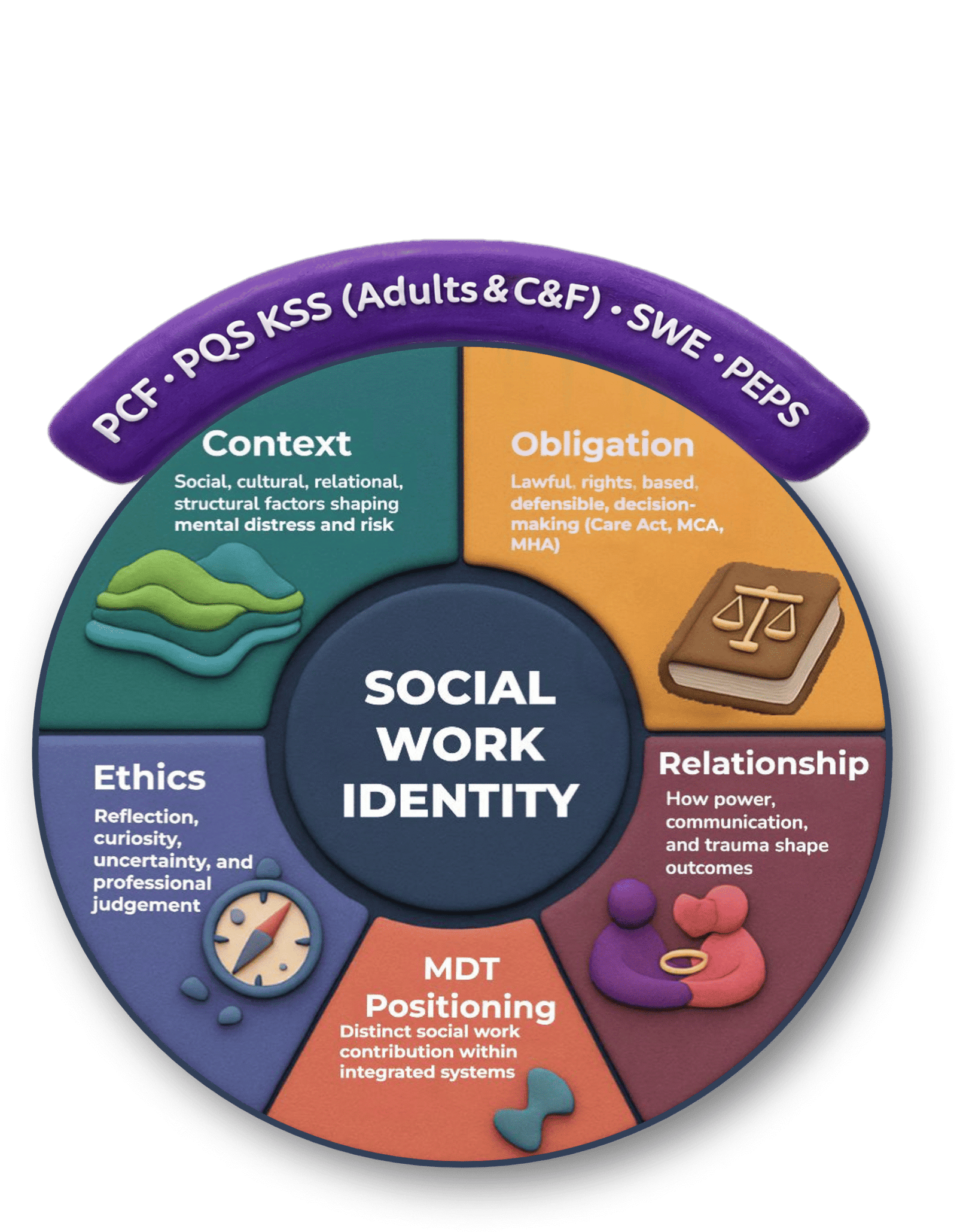
CORE-MH is introduced after the practice and policy material so it lands as a way of making sense of pressure, rather than as a front-loaded model. It frames professional identity as how social workers hold judgement, communication, boundaries and authority in action.
The model sets out mental health social work identity through five connected anchors: contextual and social lens, obligations and statutory purpose, relational and trauma-informed practice, ethical curiosity and professional judgement, and multi-disciplinary positioning.
David Cochrane has provided feedback on the CORE-MH model, and a specific forensic mental health version will be available soon.
Expand CORE-MH anchors
- C - Contextual & Social Lens: seeing the whole picture around distress, risk and need.
- O - Obligations & Statutory Purpose: using authority lawfully and proportionately.
- R - Relational & Trauma-Informed Practice: recognising that how power is used shapes outcomes.
- E - Ethical Curiosity & Professional Judgement: thinking critically under uncertainty.
- MH - Multi-Disciplinary Positioning: being distinct without becoming defensive.
Reflective close
- Which CORE-MH anchor feels strongest in current forensic practice?
- Which anchor is most pressured by current policy and system change?
- What sentence would help you explain your social work contribution clearly in an MDT?